
Yes, loft beds are safe for adults. But that answer comes with a condition that matters: they’re safe when you buy the right one. The wrong one, and there are plenty of them marketed in ways that obscure this, is a different story.
The most common mistake adults make when buying a loft bed is applying the same logic they’d use for any other bed frame. They look at the style, the price, the reviews, and they order it. What they don’t check is the weight capacity, which is the single most important specification on any raised bed and the one most likely to be buried in the product details or listed in vague terms.
This article covers what you actually need to know about loft bed safety for adults: the weight capacity question, what the frame construction tells you, the guardrail situation, and a few other things worth checking before you buy.
The weight capacity problem
Most loft beds sold online are designed primarily for children. A children’s loft bed typically has a weight capacity of 150 to 220 pounds, and that figure includes the mattress weight, not just the person sleeping on it. A standard mattress weighs anywhere from 50 to 100 pounds depending on the type and size. On a children’s loft bed, that can leave very little room for an adult before you’re already at or near the limit.
This isn’t a minor detail. Exceeding the rated weight capacity of a raised bed frame isn’t just a warranty issue, it’s a structural one. A frame that’s consistently loaded beyond its design limit will weaken over time, and a failure at height is a serious injury risk.
The fix is straightforward: check the weight capacity before buying and make sure it covers your body weight plus the weight of your mattress with meaningful headroom. For most adults, you want a minimum of 250 to 300 pounds of rated capacity after accounting for the mattress. A frame rated at 400 pounds or above gives you real peace of mind and handles a heavier mattress without strain.
Weight capacity by type at a glance
| Loft bed type | Typical weight capacity | Who it suits |
| Budget children’s loft bed | 150 to 220 lbs including mattress | Children only, not suitable for adults |
| Standard adult loft bed | 250 to 400 lbs | Most adults, check mattress weight separately |
| Heavy-duty adult loft bed | 400 to 600 lbs | Adults who want more reassurance or a heavier mattress |
| Full size / queen with desk | Up to 900 lbs (frame rating) | Adults in small spaces, home office setups |
| Custom or commercial grade | 1,000 lbs and above | Shared use, vacation rentals, higher weight needs |
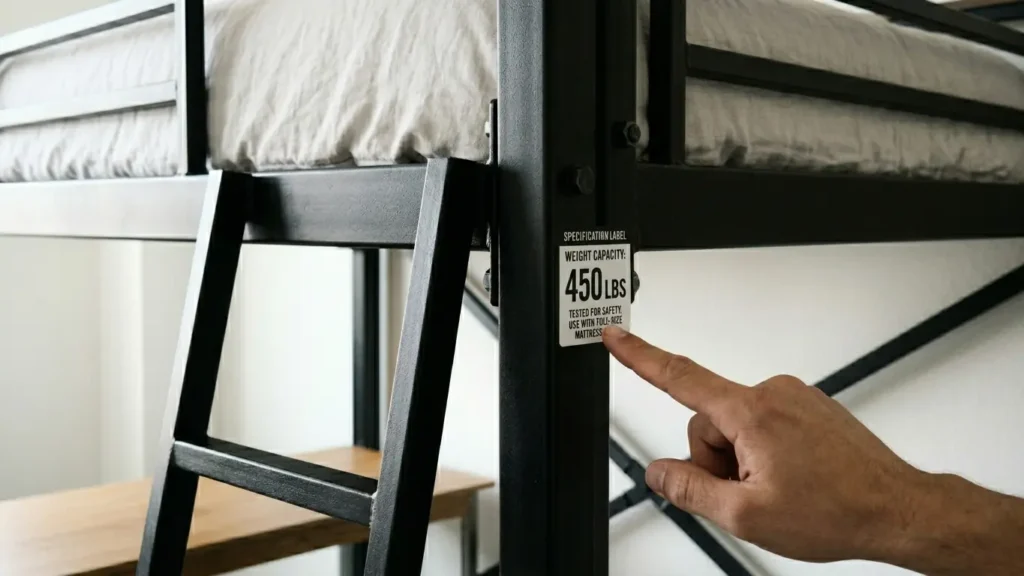
Note: weight capacity figures are general ranges. Always check the specific product listing for the exact rating before buying.
What the frame construction tells you
Weight capacity is the headline number but the construction of the frame tells you whether that number is likely to hold up over time, not just on the day it’s assembled.
Metal vs wood
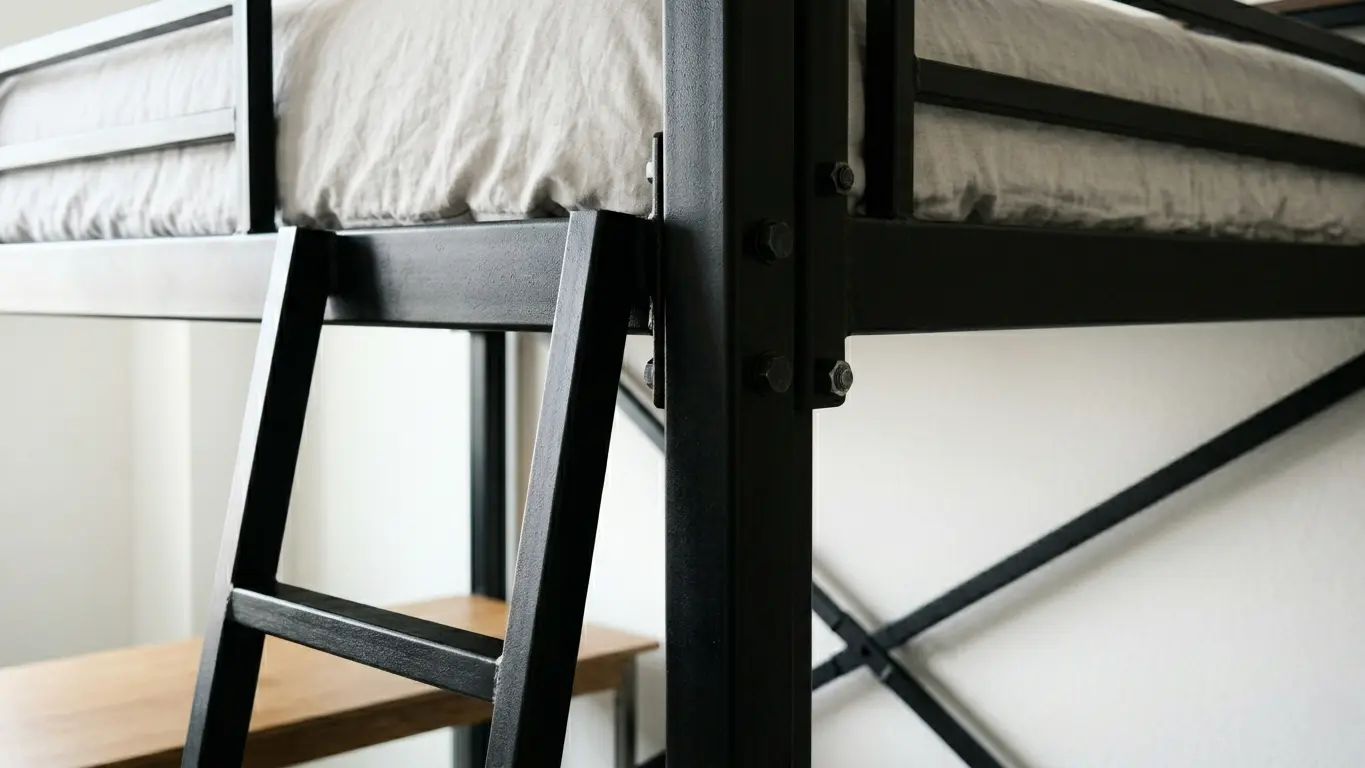
Heavy-gauge steel frames generally offer the most reliable weight capacity for the price. The key word is heavy-gauge. Thin-walled metal tubes look similar to thick-walled ones in product photos but behave very differently under load. Cheap metal frames often use thinner profiles to keep costs down, and they can develop sway and flex over time that solid frames don’t.
Solid wood frames, particularly those using pine, oak, or rubberwood, distribute weight well and feel more stable than thin metal. Engineered wood and MDF, which appear in many mid-range frames, are less reliable for an elevated bed since they’re more vulnerable to the kind of stress concentrations you get at joints and mounting points.
Connection points and joints
The joints are where most bed frames fail. Bolted connections that go through solid material are more reliable than screws into particle board or MDF. When assembling any loft bed, check that all bolted connections are fully tightened and re-check them after a few weeks of use since they can work slightly loose during the initial settling period.
A frame that develops any meaningful wobble or sway after assembly is telling you something. It either wasn’t assembled correctly or the design isn’t suited to the load it’s carrying. Don’t dismiss that signal.
Slat design
The slats that support the mattress are part of the weight-bearing system, not just a mattress base. Widely spaced slats concentrate the load on fewer contact points. Closely spaced or centre-supported slats distribute it more evenly. For an adult on a heavy mattress, this matters more than it does for a child on a light one.
Guardrails: what actually matters
Every loft bed has guardrails on the sleeping platform. The question is whether they’re high enough and solid enough to do their job properly for an adult.
The Consumer Product Safety Commission sets guidelines for guardrail heights on bunk beds, which are a useful reference point for loft beds too. The standard recommendation is that guardrails extend at least 5 inches above the top of the mattress surface. On a children’s bed with a thin mattress this is usually fine. On an adult loft bed with a thicker mattress, the same guardrail height provides less protection because the mattress surface is higher relative to the rail.
The practical implication: if you’re using a thick mattress, say 10 inches or more, check that the guardrail height listed in the product specs still provides adequate clearance above your mattress surface. Most well-specified adult loft beds account for this, but it’s worth verifying rather than assuming.
Guardrail rigidity also matters. A rail that flexes noticeably when you press against it isn’t providing the security it appears to. On a quality frame the guardrails should feel like a fixed structural element, not a bolt-on addition.

The ladder and staircase question
Getting up and down safely is the other side of loft bed safety that doesn’t get enough attention. A standard vertical ladder is functional but it’s not the most comfortable thing to use every single day, particularly last thing at night when you’re tired.
For adults using a loft bed as their daily sleep setup, a staircase is worth the extra floor space it takes up. Stairs are easier on the knees, easier to negotiate in the dark, and significantly more comfortable than a ladder for the long term. Most loft beds with built-in staircases also use the staircase steps as storage, which partially offsets the floor space cost.
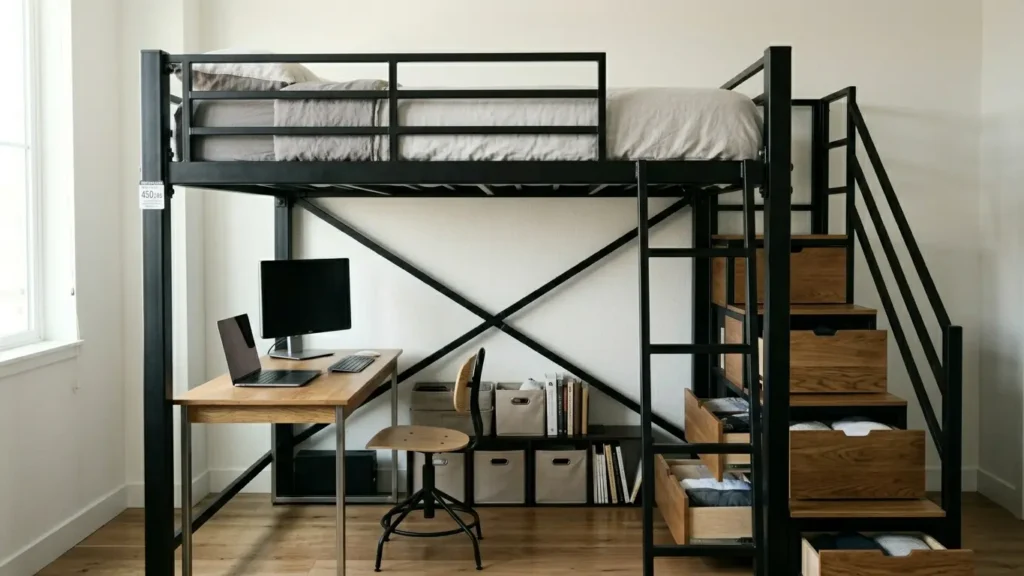
If a ladder is your only option, check that the rungs are wide enough to be comfortable for an adult foot, at least 12 inches is a reasonable minimum, and that the ladder is fixed securely to the frame rather than just resting against it. A ladder that shifts when you step on it is a fall risk that compounds every time you use it.
When a loft bed genuinely isn’t the right call
There are situations where a loft bed isn’t the right choice regardless of how well it’s built, and it’s worth being honest about them.
If you have mobility issues or find climbing a ladder or staircase regularly uncomfortable, the daily inconvenience will erode any benefit the extra floor space provides. A loft bed is a commitment to climbing every time you go to bed, and that’s fine for most people but not everyone.
If your ceiling height is marginal, meaning less than 100 inches, the sleeping clearance above the mattress may be too low to be comfortable for an adult. You can technically fit a loft bed in a lower-ceilinged room but sitting up in bed without hitting your head gets old quickly.
If you’re buying for a guest room that will be used by a wide range of people, including older guests or anyone with limited mobility, a loft bed creates more complications than it solves. The space-saving benefit has to be weighed against accessibility.
We cover the ceiling height question in detail in our article on how much ceiling height you need for a loft bed, including the exact calculations to work out whether your room is suitable before you order anything.
What to check before you buy
Weight capacity. Find the exact figure, not a vague description. Make sure it covers your body weight plus your mattress weight with room to spare. If the listing doesn’t state a weight capacity clearly, that’s a reason to look elsewhere.
Frame material and gauge. Heavy-gauge steel or solid wood for preference. Avoid MDF or engineered wood for the structural frame on a raised bed.
Guardrail height above mattress surface. Not just the guardrail height from the floor, but how far it extends above the top of your actual mattress. Account for your mattress thickness.
Ladder or staircase suitability. For daily use, stairs are worth the floor space. For occasional use, a fixed well-built ladder is fine.
Assembly quality. Every loft bed requires careful assembly. Rushed or incomplete assembly is the most common cause of instability. Take the time to do it properly and re-check the connections after the first week of use.
A well-built loft bed with an appropriate weight rating, a solid frame, proper guardrails, and careful assembly is a safe and genuinely practical choice for an adult. The risks associated with them are almost entirely down to buying the wrong product or assembling it incorrectly, not with the concept itself.
If you’re ready to look at specific beds, our guide to the best loft beds for small spaces covers the top picks across different sizes and budgets with weight capacity and frame quality factored into every recommendation.
The US Consumer Product Safety Commission publishes guidelines on bunk and loft bed safety standards, which are worth reading if you want the regulatory background on how these products are tested and what the requirements actually are.