
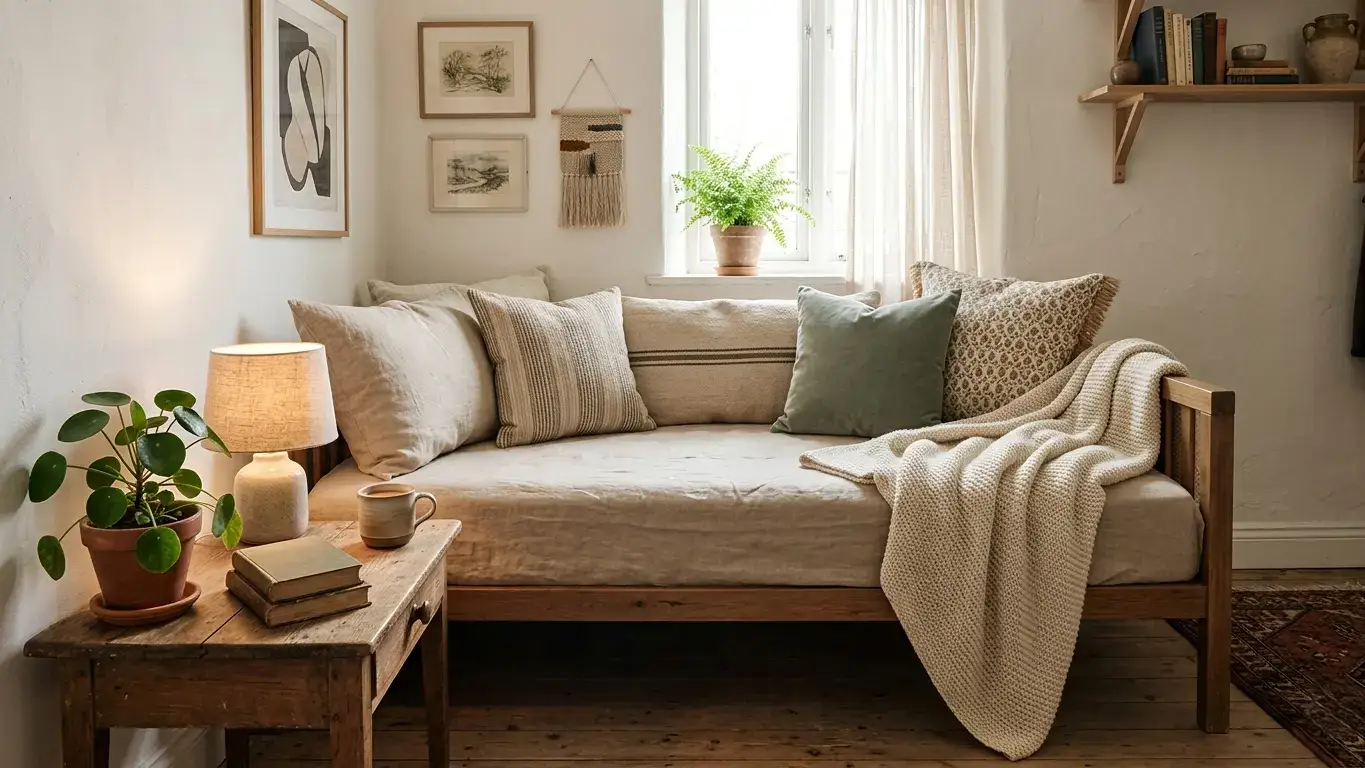
A daybed pushed against a wall with nothing on it looks exactly like what it is, a bed that someone didn’t know what else to do with. The same daybed with the right cushions, a throw, a side table and a lamp reads as a proper seating area. The furniture is identical. The difference is entirely in how it’s set up.
This article covers the practical ideas worth knowing for styling a daybed well, positioning it in a small room, and making it function properly whether it’s being used as a sofa, a reading corner, a guest bed, or all three depending on the day.
Start with position
Where the daybed sits in the room determines almost everything else. Get the position right and the styling follows naturally. Get it wrong and no amount of cushions will fix it.
Against the longest wall
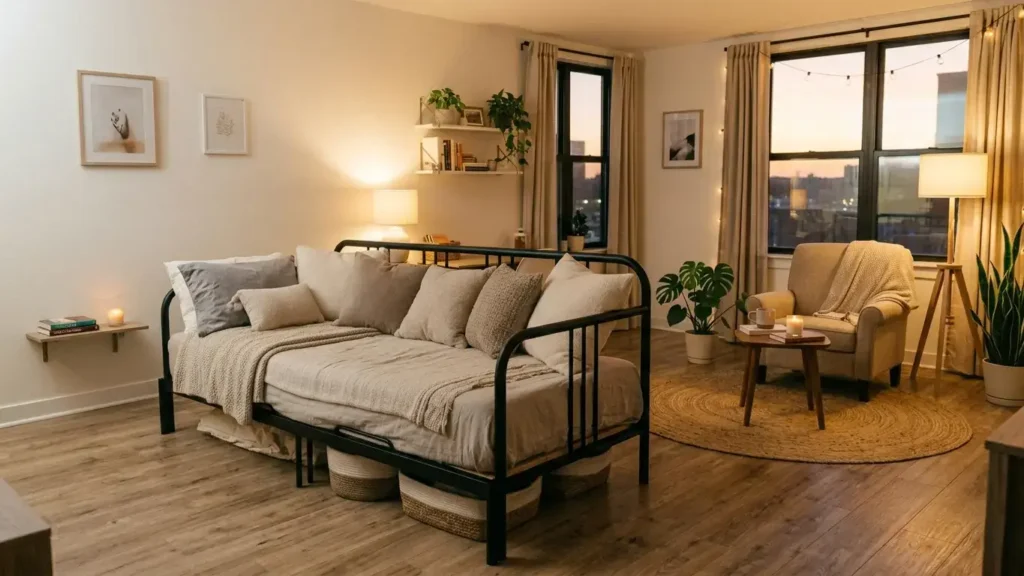
The most common and usually the most practical position. The daybed runs along the wall with the long side facing the room. This keeps the floor space in front of the daybed open, gives the room a clear sofa-like reading of the furniture, and makes the most of the wall length without the frame jutting awkwardly into the space.
In a small bedroom this position also doubles well as a sleeping layout. The pillows go at one end, the feet at the other, and the back panel becomes a natural headboard substitute. During the day, rotate the cushions to the back panel and the bed becomes a sofa.
In a corner
A daybed in a corner, with one short end against a side wall and the long back against the main wall, creates a naturally enclosed feeling that works well as a reading nook or a defined seating area. The corner gives the daybed a sense of placement and purpose rather than just being furniture pushed to the edge of a room.
The trade-off is that a corner position can make it slightly harder to get in and out from the open end, and if the daybed has a trundle it needs clear floor space on the open side for the trundle to extend. A corner daybed designed specifically for corner placement, with panels on two sides, handles this more elegantly than a standard daybed positioned in a corner.
As a room divider
In a studio apartment where the sleeping and living areas share the same space, a daybed positioned with its back facing the room rather than a wall can create a soft division between zones. The back panel of the frame acts as a low visual boundary, separating the sleeping area from the rest of the studio without a wall or a curtain.
This only works if the back panel of the frame is finished on both sides. Some daybeds are designed to be seen from both sides and some are not. Check the product images before positioning any frame away from a wall.
Cushions: the detail that does the most work
Cushions are what turn a daybed from a bed into a sofa. The arrangement matters more than the cushions themselves.
The bolster approach
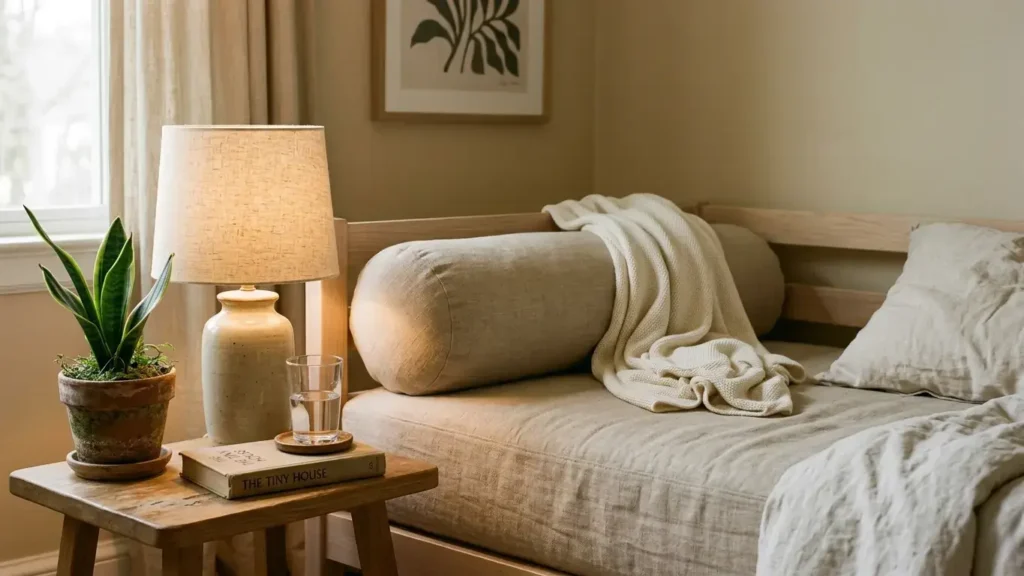
Long cylindrical bolster cushions placed along the back panel of the daybed are the most traditional daybed styling approach and for good reason. They fill the gap between the mattress surface and the back panel, creating a proper backrest that makes the daybed feel like intentional seating rather than a bed with cushions dropped on it.
Two or three bolsters running the length of the back panel, in a fabric that complements the throw, is the most reliable starting point for making a daybed look like it belongs in a room.
Layered scatter cushions
Scatter cushions arranged against the back panel in a mix of sizes give a more casual and contemporary look than bolsters. The key is odd numbers, three or five cushions, and varying the sizes from large at the back to smaller at the front. Keep the colours within a consistent palette. Three cushions in three different shades of the same colour look intentional. Three cushions in three unrelated colours look like leftovers.
How many is too many
Enough to make the back panel feel like a backrest, not so many that the sleeping surface disappears under fabric. If removing all the cushions before sleeping takes more than thirty seconds, there are too many. The test is whether the daybed still functions easily as a bed when someone actually needs to sleep in it.
The throw
A throw draped across one corner or folded across the foot of the daybed is the single fastest way to make it look like a deliberate piece of furniture rather than a spare bed. It adds texture, signals that the piece is being used and thought about, and softens the visual weight of the frame.
A chunky knit, a linen throw, or a woven blanket all work. The fabric should contrast slightly with the cushions rather than matching exactly. Exact matches look coordinated in a showroom and a little flat in a real room.
The side table question
A daybed used primarily as seating needs a surface nearby for a drink, a book, a phone. A small side table or a floor lamp with a built-in shelf at one end of the daybed solves this practically and anchors the furniture as a defined seating area rather than a floating piece of upholstered frame.
The height of the side table matters. It should sit at roughly the same level as the daybed surface, which is lower than a standard sofa. A standard side table designed for a sofa is often too tall for a daybed and looks visually awkward. Look for tables in the 18 to 22 inch height range, or use a small stool, a stack of books, or a low plant stand as an alternative.
Making it work as a guest bed without it looking like one
The challenge with a daybed in a dual-purpose room is that it should look like a sofa during the week and function as a proper bed when a guest arrives, without the room feeling like a permanent guest bedroom.
The practical approach is to keep the guest bedding stored out of sight rather than folded on the daybed surface. A storage ottoman at the foot of the daybed holds a duvet, a pillow and spare sheets without making the room feel like it’s constantly waiting for someone to arrive. When a guest comes, everything is within reach. When they leave, it goes back in the ottoman and the room reverts to its daytime function.
This also avoids the slightly uninviting look of a daybed with a duvet already on it, which reads unmistakably as a bed regardless of how many cushions are arranged on top of it.
Lighting
Overhead lighting doesn’t reach a daybed well when it’s positioned against a wall, particularly if the daybed is in a corner or recessed in any way. A floor lamp at one end, a wall-mounted reading light above the back panel, or a small table lamp on the side table all work better than relying on ceiling light.
Good task lighting at the daybed makes it a comfortable place to read, work or sit in the evening. Without it, the daybed becomes the piece of furniture people sit on only when the better-lit areas of the room are taken.
What style of daybed makes styling easier
Metal frames with simple clean lines are the most forgiving to style because they don’t impose a strong visual language on the room. A plain black or white metal frame works with almost any cushion colour and fabric choice.
Wood frames, particularly in natural pine or cherry, bring more warmth and visual weight. They suit rooms with a warmer palette and benefit from cushions in natural fabrics, linen, cotton or wool, rather than synthetics.
Heavily ornate frames, whether metal or wood, are harder to style around because the frame itself is already making a strong visual statement. Simpler cushion arrangements work better with these, letting the frame do the decorative work rather than competing with it.
If you are still deciding which daybed to buy before you style it, our guide to the best daybeds for small spaces covers the top picks across different frame styles and materials, which makes it easier to choose a frame that suits the room you have in mind.
Styling a small room well comes down to a handful of consistent principles that apply whether the piece of furniture in question is a daybed, a sofa bed or anything else. Thinking carefully about how natural light moves through the room across the day and arranging furniture around that is one of the most overlooked and most effective starting points.