
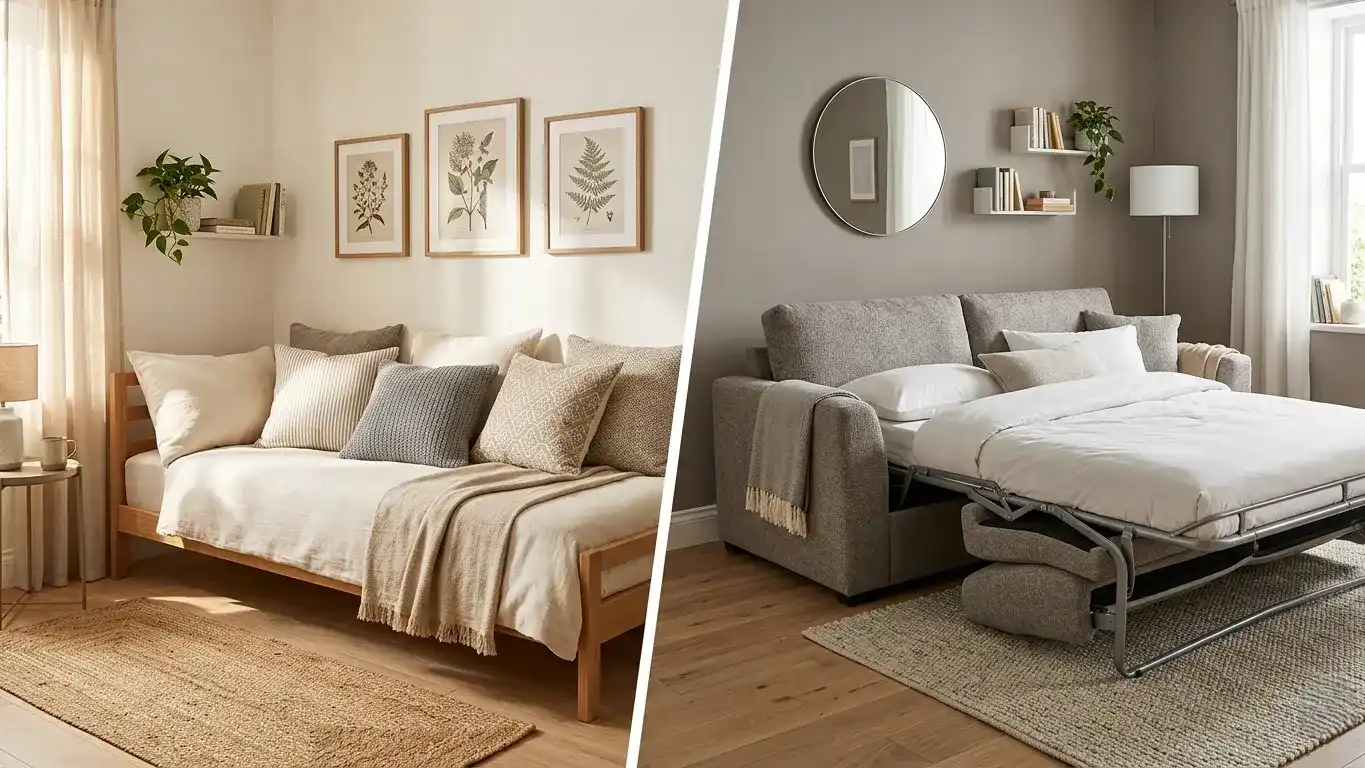
Pull-out couch and sofa bed are often used interchangeably, and a daybed gets lumped in with both of them in the same search results. They’re not the same thing, and the differences matter when you’re trying to decide which one belongs in your space.
Here’s a plain breakdown of what each one actually is, how they differ in practice, and which situations each one suits.
What a pull-out couch actually is
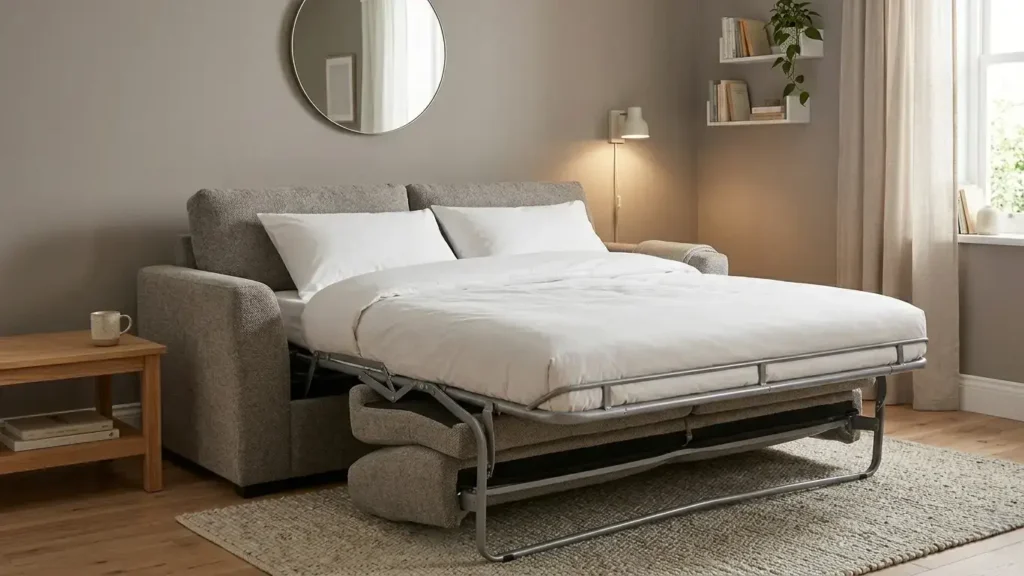
A pull-out couch, also called a sleeper sofa or sofa bed in some contexts, is an upholstered sofa with a folding metal frame and separate mattress hidden underneath the seat cushions. When you need the bed, you remove the cushions, pull a handle, and the frame unfolds to reveal the mattress lying flat. The mattress is typically 4 to 5 inches thick on budget models and slightly thicker on premium ones.
The defining feature is the hidden mechanism. During the day it looks exactly like a sofa because it is a sofa, the bed is entirely concealed. The conversion takes a couple of minutes and requires clearing the cushions and unfolding the frame fully before anyone can sleep in it.
Pull-out couches come in a wide range of sizes, from loveseat to queen, which means the sleeping surface can be significantly wider than a daybed. A queen pull-out couch can sleep two adults comfortably, which a standard twin daybed cannot.
What a daybed actually is
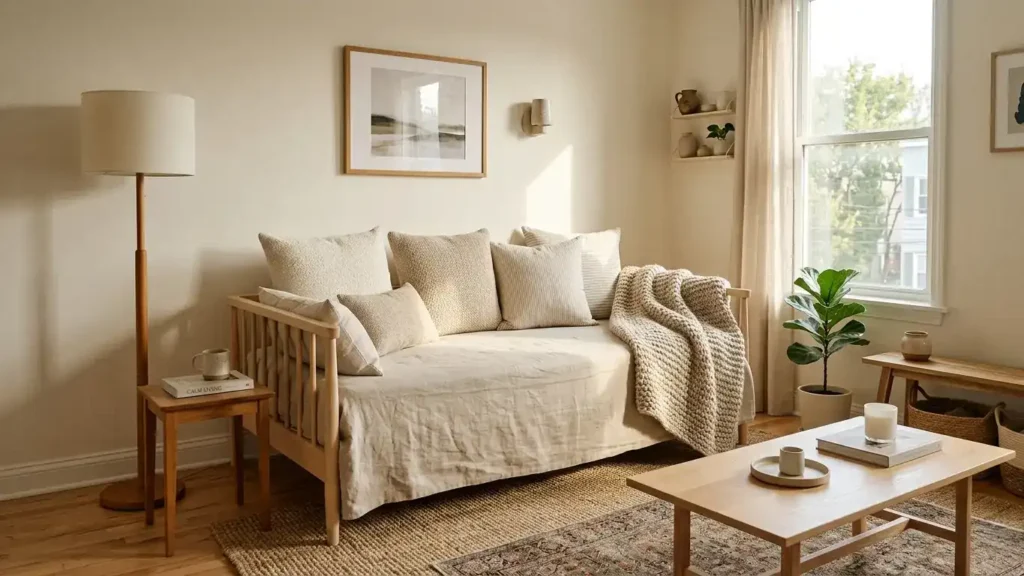
A daybed is a raised bed frame with a back panel and usually two side arms that give it a sofa-like silhouette. The mattress sits in the frame permanently, no mechanism, no hidden components, no conversion process. During the day you add cushions and it reads as seating. At night the cushions come off and it functions as a standard single bed.
The sleeping surface on a daybed is a proper mattress of your choice, typically twin size, sitting on a solid slatted frame. You choose the mattress independently and it can be as thick and as comfortable as any standard bed mattress. There’s no mechanical constraint on mattress quality the way there is with a pull-out couch.
What a daybed lacks compared to a pull-out couch is width. A standard daybed sleeps one person. It can’t accommodate two adults the way a queen sleeper sofa can.
Where the confusion comes from
The terms get muddled because both products sit in the same mental category, furniture that functions as both seating and sleeping. Some furniture retailers also use daybed loosely to describe any low-profile sofa with a flat back, which blurs the line further.
The clearest way to separate them is this: if the sleeping surface is permanently in the frame and requires no mechanical conversion, it’s a daybed. If the sleeping surface is hidden inside the sofa and unfolds via a mechanism, it’s a pull-out couch or sleeper sofa. The two products look nothing like each other up close, but they occupy a similar search space online, which is where the confusion tends to start.
How they compare in practice
Sleeping comfort
A daybed with a well-chosen mattress is more comfortable to sleep on than most pull-out couches at the same price. The mattress sits on a solid frame with no bar running across the middle, which is the most common complaint about pull-out couches. The metal bar that supports the fold-out frame on a sleeper sofa often becomes noticeable when you’re sleeping on it, particularly on thinner mattresses.
Premium pull-out couches with thicker mattresses address this to some extent, but they cost considerably more than a comparable daybed and mattress combination.
Sofa appearance
A pull-out couch looks more like a living room sofa. It has the depth, the cushioning and the proportions of proper seating furniture. A daybed looks like a bed that happens to have a back panel. Styled carefully with cushions it reads as intentional seating, but it doesn’t disappear into a living room the way a sofa does.
If the room needs to look like a living room first and a bedroom second, a pull-out couch makes that easier to achieve.
Floor space
A daybed has a fixed footprint whether it’s being used as a sofa or a bed. Nothing extends and nothing needs clearance. A pull-out couch needs significant floor space in front of it when the mattress is extended, often two to three feet depending on the model. In a small room where the furniture sits close together, this is a genuine practical constraint that can make a pull-out couch awkward to use as a bed without moving other things out of the way first.
Guest sleeping capacity
A queen or full size pull-out couch sleeps two adults. A standard daybed sleeps one. If you regularly need to sleep two guests in the same piece of furniture, a pull-out couch is the only option between the two. A daybed with a pop-up trundle underneath adds a second sleeping surface at floor level, which solves the two-guest problem without needing a wide sleeper sofa, though the two surfaces are separate rather than one large shared bed.
Setup and daily use
A daybed requires no setup. The sleeping surface is always ready. A pull-out couch requires removing cushions, pulling out the frame, and making up the bed before anyone sleeps in it, then reversing the process in the morning. For occasional guest use this is a minor inconvenience. For daily use as a primary sleeping surface it becomes a meaningful hassle.
| Daybed | Pull-out couch | |
| How it converts | No conversion, mattress is permanent | Cushions removed, frame unfolds mechanically |
| Sleeping surface | Full mattress of your choice | Thinner fold-out mattress, bar underneath |
| Sleeping capacity | One adult (twin size standard) | One or two adults depending on size |
| Sofa appearance | Sofa-adjacent, reads as bedroom furniture | Looks like a proper living room sofa |
| Floor space when in use | Fixed footprint, no extension | Extends outward, needs clearance |
| Daily use | No setup or pack-down needed | Conversion required each time |
| Best for | Regular sleeping, guest rooms, studios | Living rooms, occasional guests, two sleepers |
Which one is right for your situation?
Get a daybed if: the room is a bedroom or guest room rather than a living room, the sleeping surface will be used regularly, you want to choose your own mattress, or the room doesn’t have floor space for a pull-out to extend.
Get a pull-out couch if: the room is primarily a living space and the sofa appearance matters, you occasionally need to sleep two guests in the same piece of furniture, or the sofa function genuinely needs to feel like a proper sofa rather than a styled bed.
It’s also worth knowing that a daybed and a pull-out couch are not the only options in this space. A futon folds down from the backrest rather than pulling out from underneath, which is simpler mechanically and often more affordable. And a daybed with a trundle adds a second sleeping surface that stays hidden until needed, which addresses the two-guest problem without the width of a queen sleeper sofa.
If you’ve worked out that a pull-out couch or sofa bed is actually the direction you want to go, our guide to the best sofa beds for small apartments covers the top options with honest assessments of sleeping comfort and sofa function at different price points.
If a daybed is where you’ve landed, our guide to the best daybeds for small spaces covers the top picks across different styles and materials so you can find the right one for your room.
When a room needs to do more than one thing, getting the furniture choice right matters more than most people realise before they buy. This guide on multifunctional furniture ideas for small spaces covers the practical principles worth thinking through before you commit to anything.