
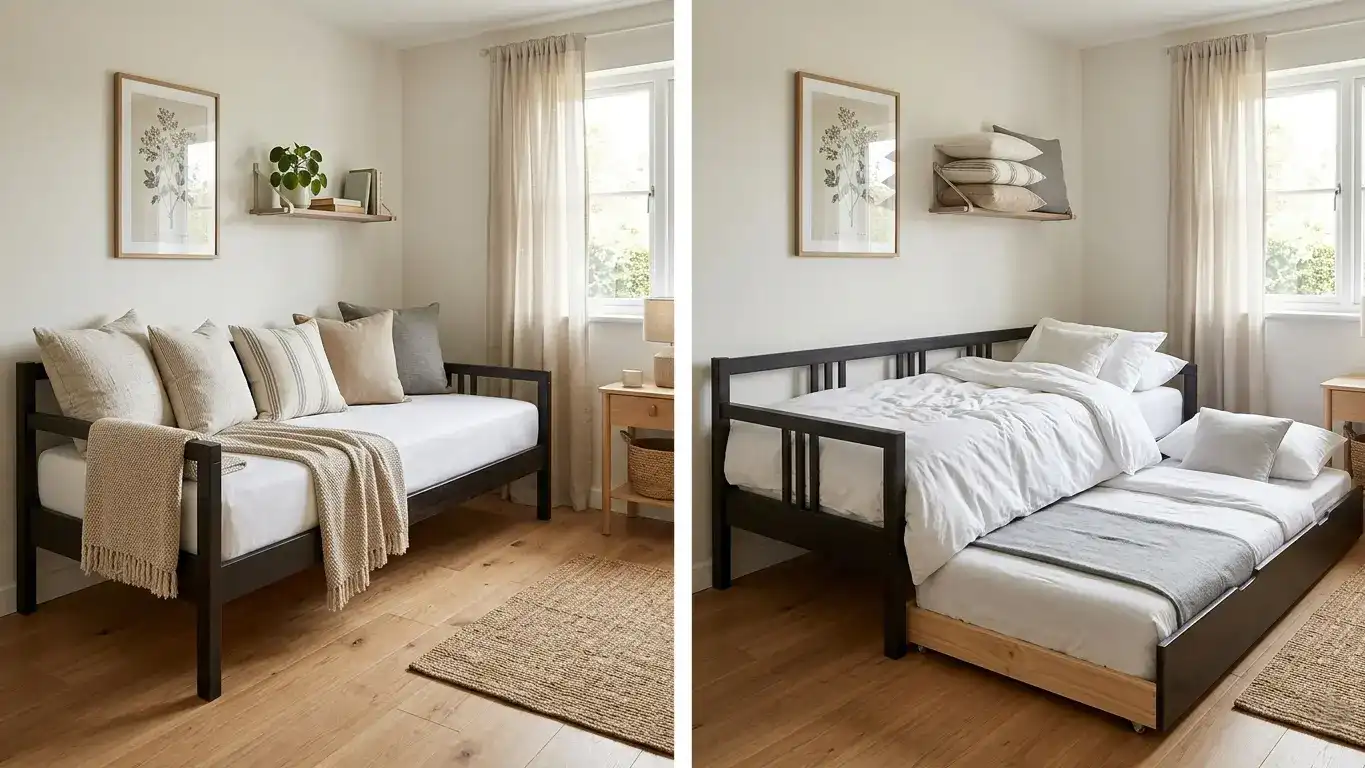
A daybed with trundle costs more than a standard daybed, takes up slightly more visual weight in a room, and adds a second sleeping surface you may or may not ever use. Whether that trade-off makes sense depends entirely on how you’re actually going to use the room.
This isn’t a complicated decision once you ask the right question. Here’s how to work it out.
Start with one question
Do you regularly need to sleep two people in this room?
If the answer is yes, even occasionally, a daybed with trundle is almost certainly the right call. The trundle solves a real problem and the extra cost is justified.
If the answer is no, you’re paying more for something that will spend its entire life pushed under the main frame. A standard daybed does everything you need at a lower price and with a slightly cleaner look in the room.
Everything else, the style, the material, the price point, comes after you’ve answered that first question honestly.
What you actually get with a trundle
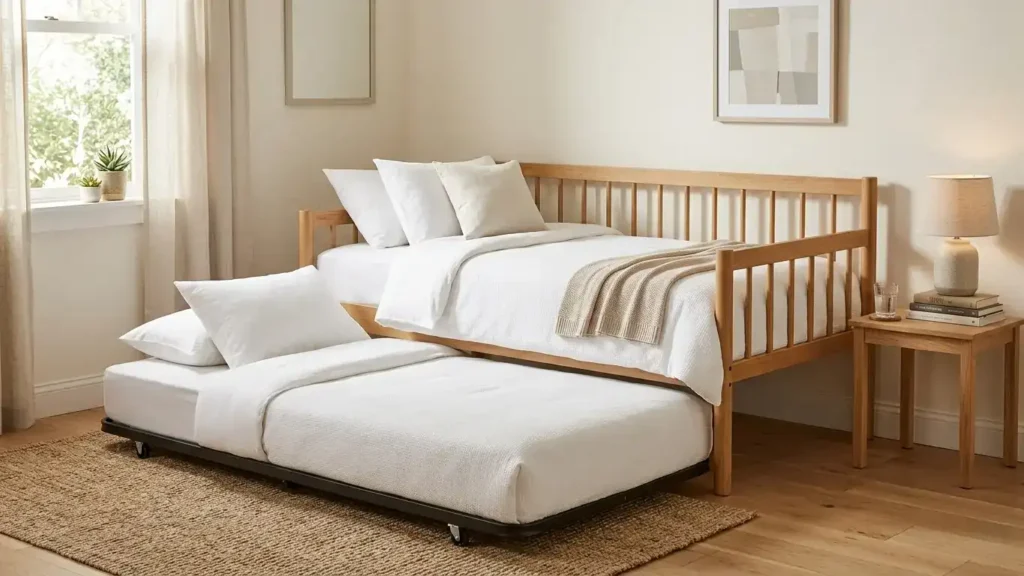
A trundle is a second bed frame on wheels that stores underneath the main daybed. When someone needs to sleep in it, it pulls out and sits on the floor beside the main frame. Most trundles accommodate a standard twin mattress up to around 6 to 8 inches thick, sitting at floor level when in use.
Some trundle designs use a pop-up mechanism that raises the trundle frame to the same height as the main bed once pulled out. These are more comfortable for adults and allow the two beds to be pushed together into one larger surface. Pop-up trundles tend to cost more than roll-out versions but are worth it if the trundle will be used regularly by adults rather than just children.
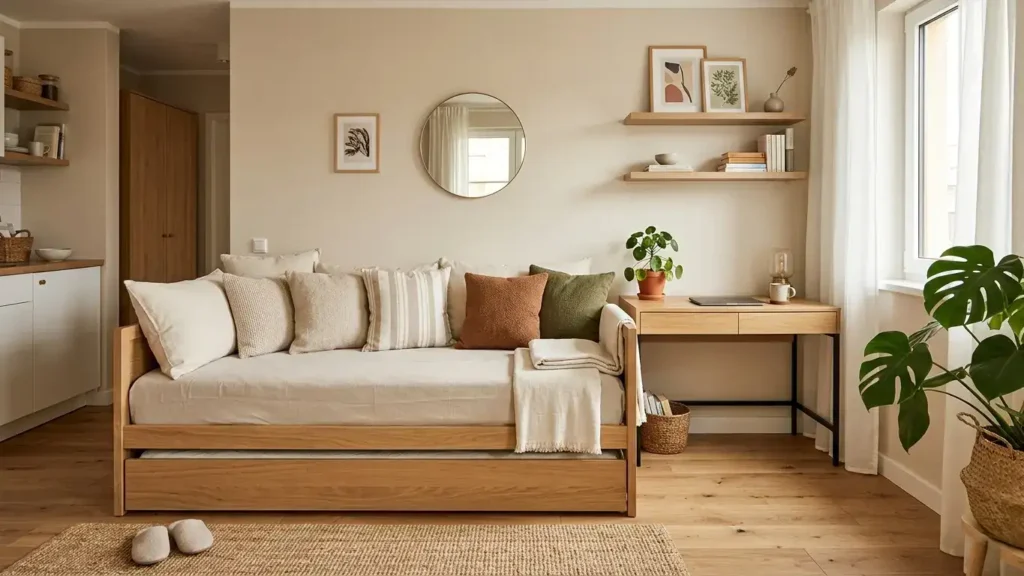
During the day the trundle is completely hidden. The room looks exactly the same as it would with a standard daybed. That’s the practical appeal: you’re adding sleeping capacity without permanently changing how the room looks or functions on a normal day.
When a standard daybed is the better choice
You only ever need one sleeping surface
If the room is for one person and guests either don’t stay or can sleep elsewhere, a standard daybed gives you everything a trundle version does without the added cost. The sleeping surface is identical. The sofa function is identical. You’re just not paying for a feature you’ll never use.
The room is on the smaller side
A trundle needs clear floor space on at least one side of the main frame to pull out fully. In a very compact room where the daybed sits in a corner or between two walls, there may not be enough clearance for the trundle to function properly. A standard daybed fits tighter layouts more easily.
Aesthetics matter more than sleeping capacity
A standard daybed tends to look slightly sleeker than a trundle version because the frame sits lower to the ground and there’s no visible gap underneath. If the room is styled carefully and the furniture is meant to look intentional rather than functional, a standard daybed fits that goal better.
Budget is the binding constraint
A daybed with trundle costs more than a comparable standard daybed. If the budget is tight and the trundle would genuinely never be used, the money is better spent on a better mattress or better quality frame rather than a second sleeping surface you don’t need.
When a daybed with trundle is the right call
You have a guest room that sits empty most of the time
A daybed with trundle is one of the more practical solutions for a guest room that also needs to function as a usable space during the week. During the day it’s a reading seat or a sofa. When guests arrive, the trundle pulls out and you have two sleeping surfaces without moving any other furniture.
You have children who have friends stay over
Sleepovers are the trundle’s most natural use case. The second bed is there when you need it and invisible when you don’t. For children specifically, the low height of a roll-out trundle is not a problem and often a preference. A daybed with trundle in a child’s room handles the sleepover situation without dedicating floor space to a permanent second bed.
You’re furnishing a studio or one-bedroom apartment
If you occasionally host guests in a small apartment and you don’t have a spare room, a daybed with trundle means you can offer a proper sleeping surface without buying a separate sofa bed or air mattress. The trundle lives under the main frame until someone needs it.
You want the option of sleeping two adults comfortably
This is where a pop-up trundle specifically earns its place. A roll-out trundle at floor level is fine for children and younger guests but less comfortable for adults who need to be there for more than one night. A pop-up trundle that raises to bed height and can combine with the main bed into one larger surface is a meaningfully better experience for adult guests.
| Standard daybed | Daybed with trundle | |
| Sleeping surfaces | One | Two |
| Best for | Single sleeper, sofa function, aesthetics | Guests, sleepovers, occasional second sleeper |
| Room size requirement | Fits tighter layouts | Needs clearance on one side for trundle |
| Price | Lower | Higher |
| Daytime appearance | Clean and minimal | Same, trundle hidden underneath |
| Adult comfort on second bed | N/A | Better with pop-up trundle |
The one thing most people overlook
Floor clearance. A trundle needs enough space to pull out fully on at least one side of the main frame. Before you order a daybed with trundle, measure the room and work out exactly where the trundle will go when it’s in use. If the bed is going against a wall on both long sides or into a tight corner, the trundle may not function properly.
Most daybed with trundle listings specify the dimensions of the trundle when extended. Add that length to the main frame length and make sure the total fits within the room with enough space to walk around it comfortably. Getting this wrong is a frustrating and expensive mistake.
We go through the exact measurements in our article on how much space you need for a daybed with trundle, including the minimum room dimensions for different frame sizes.
Which one should you actually buy?
If someone is going to sleep in that room on a second bed at least a few times a year, get the trundle. The cost difference is not substantial enough to justify turning away guests or inflating an air mattress in the hallway.
If the room is genuinely for one person and guests either don’t come or sleep elsewhere, get the standard daybed. Spend the difference on a better mattress. The sleeping experience will be better and the room will look cleaner.
When you’re ready to look at specific options, our guide to the best daybeds with trundle for small rooms covers the top picks across different styles and budgets. If a standard daybed without a trundle is what you’re after, our guide to the best daybeds for small spaces has those covered separately.
If you’re still working out how to approach a room that needs to do more than one thing, this Apartment Therapy piece on making dual-purpose bedrooms work has some useful perspective from interior designers on how to think about furniture choices in rooms with competing demands.