
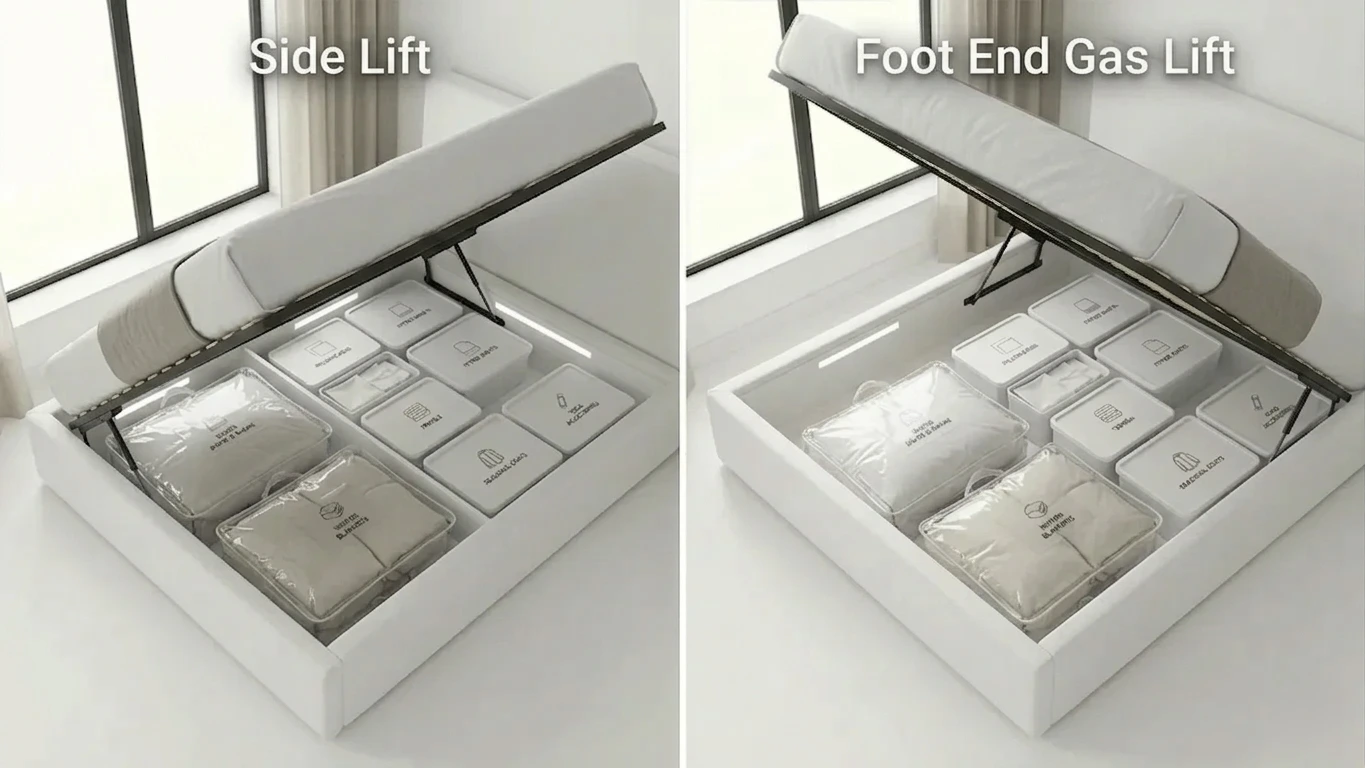
When you start shopping for an ottoman bed, you’ll quickly notice that not all of them lift the same way. Some open from the foot of the bed. Some open from the side. And the way the lifting mechanism is built varies too, with most modern beds using gas pistons but older or cheaper models using springs instead.
It sounds like a small detail, but it’s actually one of the most important decisions you’ll make when buying an ottoman bed. Get it wrong and you’ll either struggle to access your storage, or you’ll find the bed doesn’t even fit the way you planned to position it.
This guide breaks down the real difference between gas lift and side lift ottoman beds, what each one is actually better for, and how to make the right call for your specific room.
Clearing Up the Terminology First
There’s a bit of confusion in how these terms get used, so let’s clear it up before we go further.
‘Gas lift’ refers to the type of mechanism used to support the base as it opens, specifically hydraulic gas pistons, the same kind used in office chairs and car boots. It’s a description of how the lift works, not where it opens from.
‘Side lift’ refers to the direction the bed opens, from the side rather than the foot end. Side lift beds almost always use gas pistons too, so when people say ‘gas lift vs side lift,’ they usually mean ‘foot end lift vs side lift.’ The mechanism in both cases is typically gas-powered.
So the real comparison here is actually two separate questions. First, where does the bed open from, foot end or side? And second, what type of lift mechanism does it use, gas pistons or springs? We’ll cover both.
Foot End Lift vs Side Lift: Where Does the Bed Open?
This is the decision that affects your room layout the most, so it deserves the most attention.
Foot End Lift Ottoman Beds
A foot end lift ottoman opens by lifting the base from the bottom of the bed upward. The gas pistons are usually positioned along the foot end or slightly inside the frame, and the whole base tilts up like a chest lid, with the foot end rising first.
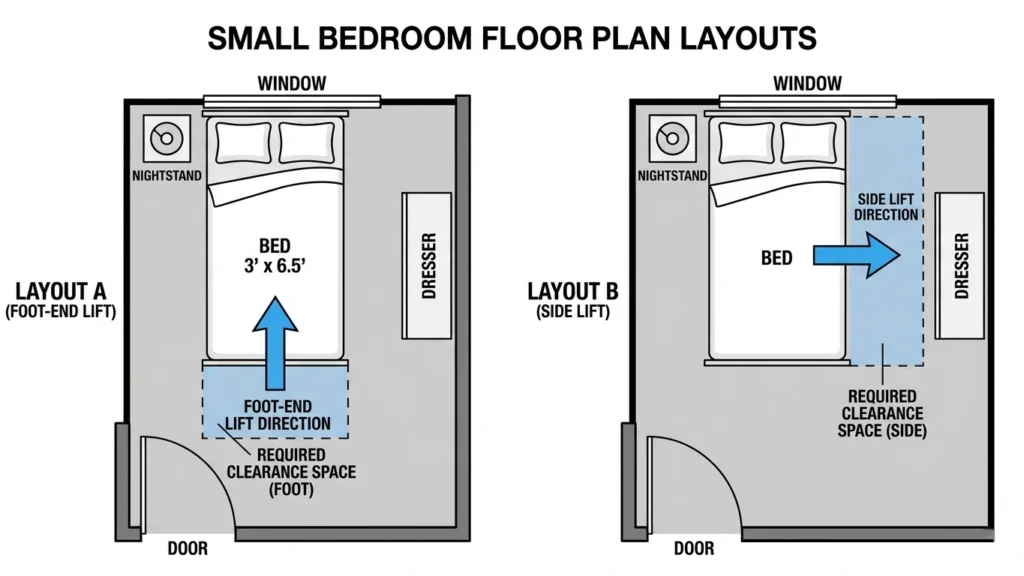
To use it, you need clear floor space at the foot of the bed. How much space depends on the bed length, but as a rough guide, you’ll want at least 60 to 80cm of clearance in front of the foot end so you can stand comfortably while the base is raised.
Foot end lift beds work well when:
- The foot of your bed faces into open room space, not a wall or wardrobe
- You have a standard bedroom layout with the bed pushed against a side or back wall
- You want slightly easier access to the full depth of the storage, since you’re lifting from one end and can reach in from the front
Side Lift Ottoman Beds
A side lift ottoman opens from the left or right side of the bed. The gas pistons run along one side of the frame, and the base lifts upward from that side, staying open on its own while you access the storage.
You need clear space on whichever side the bed opens from, typically around 50 to 70cm, enough to stand beside it and lift comfortably. Most side lift beds are available in left-hand or right-hand opening versions, so you can choose whichever side of your room has more space.
Side lift beds work well when:
- The foot of your bed is close to a wall, wardrobe, or other furniture
- You have more floor space on one side of the bed than the other
- You’re in a small bedroom or studio where the bed is positioned in a corner or against two walls
- You want more flexibility in how you position the bed in the room
Foot End Lift vs Side Lift: Quick Comparison
| Foot End Lift | Side Lift | |
| Clearance needed | Foot of bed (60-80cm) | One side of bed (50-70cm) |
| Best for | Standard room layouts | Small rooms, corner positions |
| Opening feel | Wide, easy to reach full depth | Narrower access angle |
| Flexibility | Less flexible on placement | Left or right hand options |
| Bed against wall at foot? | Not suitable | Works fine |
Gas Pistons vs Springs: Which Lift Mechanism Is Better?
Now for the second part of the comparison: the actual mechanism that does the lifting.
Gas Lift Pistons
Gas lift pistons use compressed gas in a sealed cylinder to provide a smooth, controlled resistance as the base lifts. The same basic technology is used in everything from office chairs to surgical equipment, and it’s well proven for this kind of application.
In practice, a gas lift ottoman bed feels effortless to open. You lift with a small amount of force, the pistons take over, and the base rises steadily and stays open on its own without you having to prop it up or hold it. Closing is equally controlled, you guide it down and it descends smoothly rather than dropping.
Gas pistons are rated by weight capacity, and a good quality bed will have pistons rated to handle both the mattress weight and a fully loaded storage compartment. This is worth checking when you buy, particularly for king size beds where the base is significantly heavier.
Spring Mechanisms
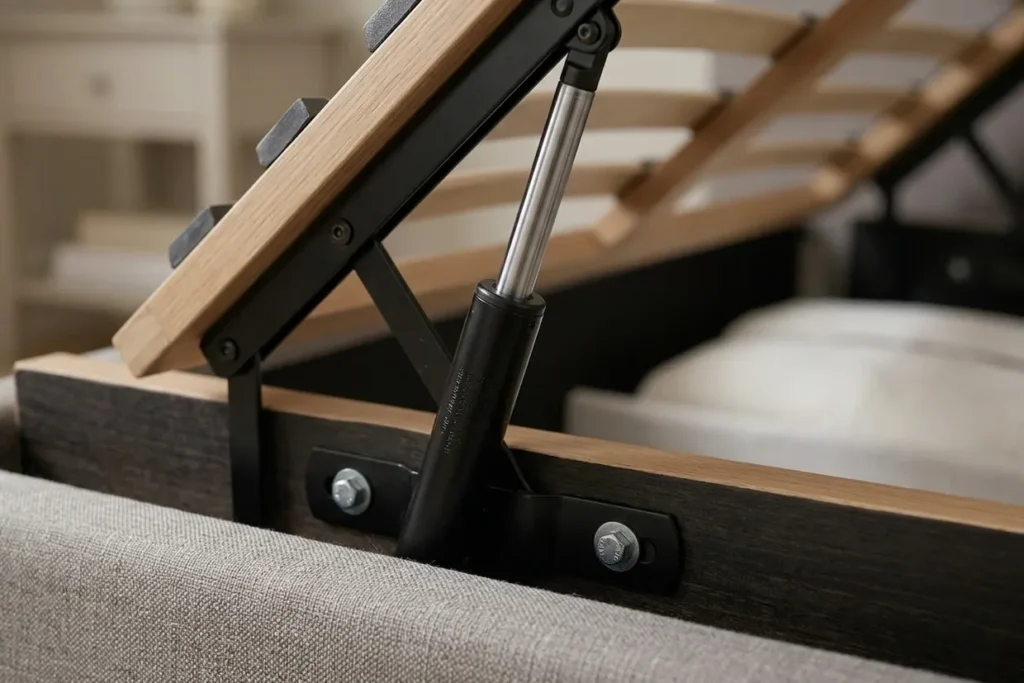
Spring-loaded ottoman beds use tension springs rather than gas pistons to assist the lift. They’re more common in older designs and budget beds, and they work, but with a few notable drawbacks.
Springs provide less consistent resistance than gas pistons. The lift can feel more abrupt, especially when the storage is empty versus full, because the spring tension stays roughly the same regardless of how much weight is in the compartment. Over time, springs can also lose tension and start to feel weaker, which makes the base heavier to lift manually.
Some spring systems also don’t hold the base fully open on their own, which means you need to prop it with a rod or hold it while you reach in. Not a dealbreaker, but noticeably less convenient than a gas lift that stays up hands-free.
How Many Gas Pistons Does an Ottoman Bed Need?
This is a question that doesn’t get asked enough. The number of pistons in an ottoman bed affects how evenly the weight is distributed as the base lifts, and how well it holds up over time with regular use.
Most double ottoman beds come with two pistons, one on each side of the lift point. King and super king sizes often have three or four. As a general rule, more pistons means a more balanced lift and less strain on the frame and hinges.
When comparing beds, look for the total weight rating of the piston system rather than just the number of pistons. A bed rated to 200kg with two pistons is better than one rated to 100kg with three. The total capacity matters more than the count.
So Which One Should You Actually Choose?
Here’s the honest answer broken down by situation:
Choose a foot end lift if…
Your bed will sit with the foot facing into open room space and you have at least 60 to 80cm clear in front of it. This is the more common setup in standard bedrooms and tends to feel slightly more natural to use because you’re standing at the end of the bed rather than leaning over the side.
Choose a side lift if…
Your bedroom is small, your bed sits with the foot end close to a wall or furniture, or you want more control over exactly where the bed can be positioned. Side lift beds are more versatile for awkward room layouts, which is why they tend to be the more popular choice in studio apartments and smaller flats.
If you’re still unsure which layout works for your room, it helps to sketch out your floor plan and check the clearance on each side before you buy. Research on how room layout affects daily comfort and sleep quality suggests that ease of movement around the bed matters more than most people factor in when they’re shopping.
Always choose gas pistons over springs…
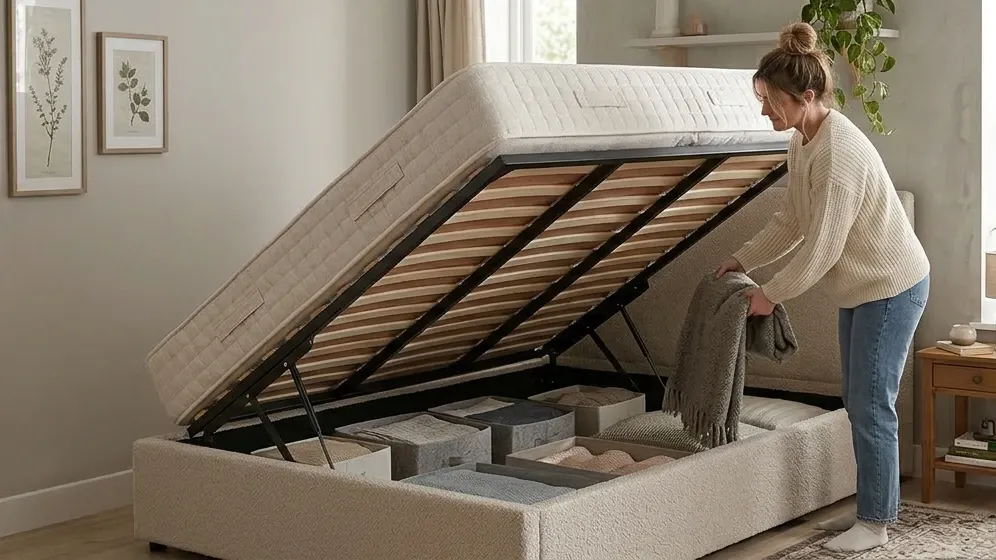
Unless you’re buying a bed you’ll barely use and budget is very tight. For any ottoman bed you’re planning to open more than a few times a month, gas pistons are noticeably better in every way, smoother to operate, more consistent over time, and easier to use without straining your back.
Frequently Asked Questions
Can you change a foot end lift to a side lift?
No, not practically. The piston mounts, hinge points, and frame reinforcements are built differently for each lift direction. It’s not something you can retrofit after purchase. Make sure you choose the right lift direction for your room before you buy.
How long do gas lift pistons last on an ottoman bed?
On a well-made bed with quality pistons, you should get 10 years or more with regular use. Cheap pistons on budget beds can start to weaken after two to three years. If a piston does fail, most can be replaced independently without buying a new bed, provided the manufacturer or retailer stocks spare parts.
Does a heavier mattress affect how easy the bed is to lift?
Yes. A heavy hybrid or latex mattress adds significant weight to the base, which means the pistons have to work harder. Always check the weight rating of the lift mechanism against the combined weight of your mattress and the items you plan to store. Most manufacturers list this in the product specs.
Is a side lift ottoman bed harder to use than a foot end lift?
Not harder, just slightly different. With a side lift you’re standing beside the bed rather than at the foot, and the access angle into the storage is narrower. Most people find it straightforward after the first couple of uses. If you have limited mobility or a bad back, a foot end lift can feel more natural since you’re not leaning over the side rail.
The Bottom Line
The gas lift vs side lift question is really two questions in one. On the mechanism side, gas pistons win over springs every time for everyday use. On the direction side, it comes down to your room layout, specifically where your bed sits and which direction has the most clearance.
If you haven’t already, it’s worth reading our guide on what an ottoman bed actually is and how the full mechanism works before you start comparing specific models.
And if you’re also weighing up whether an ottoman bed is actually the right storage solution for your specific room, our article on whether ottoman beds are worth it in small bedrooms covers the full cost and space trade-off.
When you’re ready to look at specific models, our guide to the best ottoman beds for small apartments includes options across different lift types and budgets.