
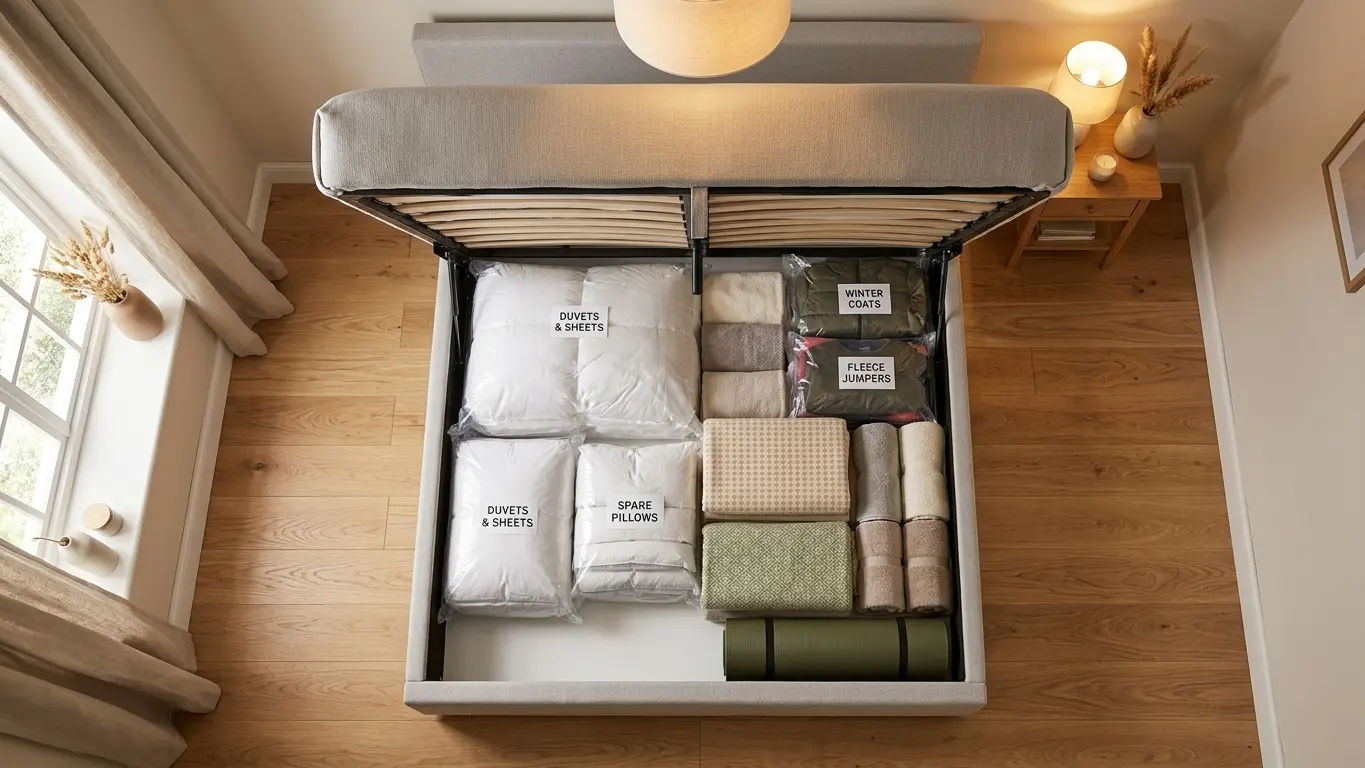
Most people buying a storage bed picture throwing a few spare things under there and calling it done. Then the bed arrives, they lift the base for the first time, and one of two things happens. Either they’re genuinely surprised by how much space there is, or they realise they have no idea how to actually use it well.
So let’s talk real numbers. How much does a double storage bed actually hold, what fits comfortably, what doesn’t, and what quietly eats into your capacity if you’re not paying attention.
The Actual Numbers
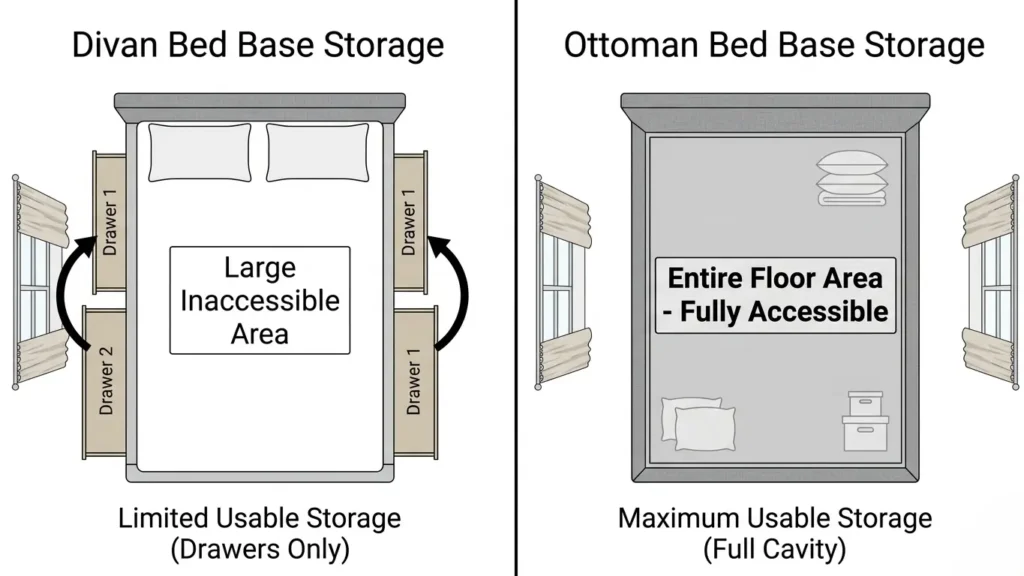
A standard double bed in the UK measures 135cm wide by 190cm long. In the US, a full size runs slightly larger at 137cm by 191cm. Close enough that the storage capacity is roughly the same either way.
The internal depth of an ottoman storage compartment, meaning the height between the floor and the underside of the base platform, typically runs between 25cm and 35cm. Most well-made double ottoman beds land at around 28 to 30cm of usable depth.
Do the maths and you get somewhere between 380 and 540 litres of total volume. For context, a standard four-drawer chest of drawers holds around 200 to 250 litres. You’re looking at roughly double that capacity, hidden underneath a piece of furniture you were buying anyway.
That’s the headline figure. But a few things will quietly reduce what you can practically fit in there, so it’s worth knowing about them before you start planning what goes where.
Things That Quietly Reduce Your Usable Space
The gas lift mechanism takes up a corner or two
The pistons and hinge hardware sit inside the storage cavity, usually in the corners near the lift point. On a double bed this accounts for maybe 10 to 15 litres of space you can’t really use. It’s not a big deal, but don’t try to wedge a shoebox right into those corners. It won’t close properly and you’ll have to spend five minutes fishing it back out.
Give the hinge area a few centimetres of clearance and you’ll be fine.
The depth isn’t perfectly even throughout
Retailers advertise the maximum internal depth, measured at the deepest point, usually the centre. Near the edges, the base platform has a lip or edging that sits slightly inside the outer frame, which means the usable depth is slightly shallower there.
In practice, soft items like clothing and bedding don’t care about this at all. They compress and conform. Rigid items like boxes or hardback books can be awkward if you push them right to the edges. Keep the rigid stuff towards the middle and you won’t have any issues.
There’s no ventilation in there
The storage compartment is completely enclosed, which is great for keeping dust out. But it also means moisture has nowhere to go. Store something that isn’t fully dry, freshly laundered clothes that weren’t quite finished drying, a damp gym bag, anything with residual moisture, and you will end up with a musty smell. Eventually mould.
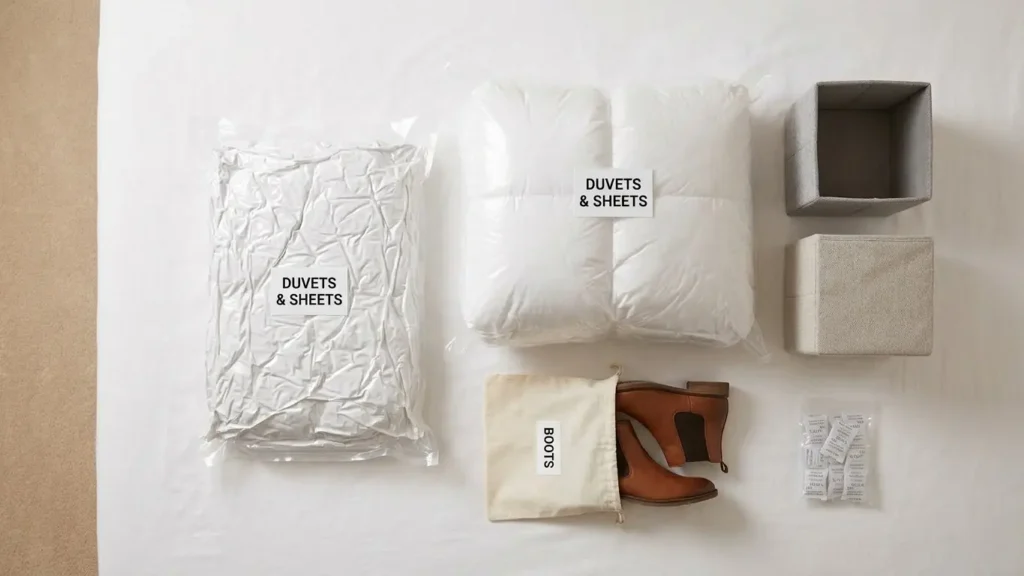
Everything going in needs to be properly dry. If you live somewhere particularly humid, a couple of silica gel packets thrown in costs almost nothing and saves you a genuinely unpleasant problem down the line.
What Fits Well and What Doesn’t
| Fits well | Worth thinking twice about |
| Extra duvets and spare bedding | Large rigid suitcases (check depth first) |
| Out-of-season clothing | Heavy gym equipment or weights |
| Spare pillows and pillowcases | Anything damp or not fully dry |
| Towels and extra linens | Items you need to access every single day |
| Shoes and boots in dust bags | Rigid stacked boxes near hinge corners |
| Vacuum-packed clothing bags | |
| Rolled yoga mats and foam rollers | |
| Small backpacks and soft bags |
Getting More Out of the Space You Have
The people who get the most out of their ottoman beds are the ones who treat it like a proper storage system rather than a dumping ground for things they don’t know what to do with. A few simple habits make a real difference.
Vacuum bags are worth every penny
A king size duvet normally takes up around 40 to 50 litres of space. Vacuum compressed, it drops to 10 to 15 litres. That’s the difference between fitting one duvet or fitting three. If you have spare guest bedding or seasonal duvets, vacuum bags in an ottoman bed are a genuinely transformative combination.
The bags also protect against the moisture issue mentioned earlier, since most vacuum storage bags are airtight. Two problems solved at once.
Soft-sided bags over rigid boxes
Rigid boxes look tidy on shelves but they’re awkward under a lift-up base. They don’t compress, they’re harder to reposition, and tall ones can jam against the base platform when you’re trying to lower it. Soft fabric storage cubes and zip bags conform to the space much better and are easier to pull out when the base is only partially lifted.
Put the most-used things on top
Seasonal items and things you rarely touch go to the back and the bottom. Things you access more regularly go on top and near the lift opening. It sounds obvious but most people pile things in randomly and then complain it’s hard to find anything.
Spend ten minutes organising it properly once and you’ll barely need to think about it again.
How It Compares to Other Storage Furniture
Since we’re dealing in numbers, here’s how a double ottoman bed stacks up against other common bedroom storage options:
| Furniture | Approximate usable volume |
| Double ottoman bed | 380 to 540 litres |
| 4-drawer chest of drawers | 200 to 250 litres |
| Double drawer divan bed | 150 to 200 litres |
| Large under-bed storage box | 50 to 80 litres |
| Blanket box or storage ottoman | 100 to 150 litres |
The ottoman bed row is highlighted because, honestly, nothing else in a bedroom comes close for the floor space it uses. You’re not buying extra furniture, you’re just using the space that was already there.
A Few Questions Worth Answering
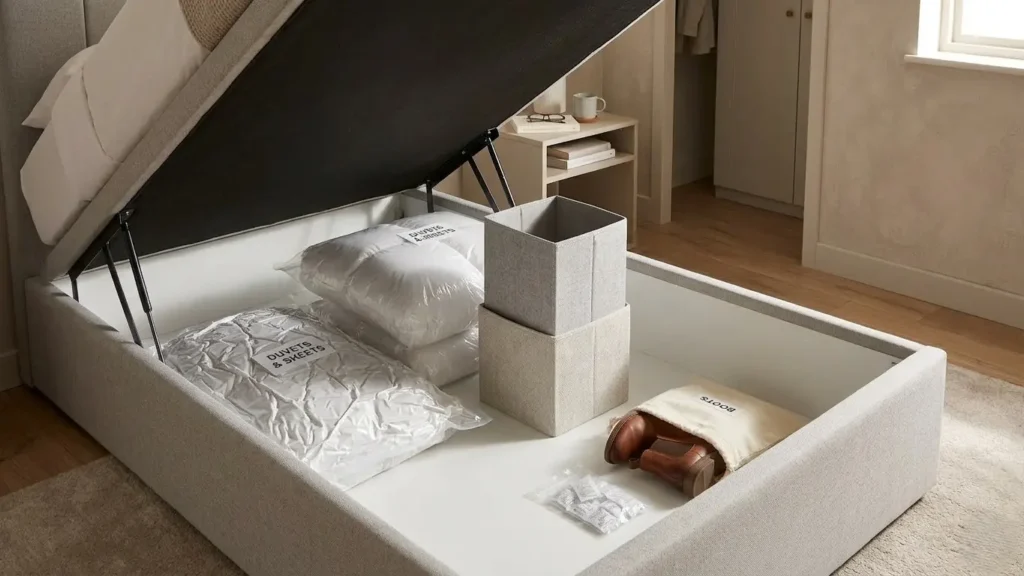
Will a large suitcase fit in a double ottoman bed?
A cabin bag or small weekend bag, easily. A large checked suitcase is trickier. Most large cases stand 75 to 80cm tall upright, which is way more than the 28 to 30cm of depth you’re working with. Laid flat, a large case can be 50 to 60cm at its widest point, which might work depending on the bed length but it’s tight. Measure your case before assuming it’ll fit. Tape measure mistakes are not fun to discover after delivery day.
Does a thicker mattress reduce the storage space?
No. The storage is underneath the base platform and the mattress sits on top of it. A thicker mattress makes the bed sit higher off the ground but doesn’t affect the internal storage depth at all.
Is there a difference in capacity between UK and US double beds?
Very slightly. A US full size is a few centimetres wider and longer than a UK double, which adds maybe 20 to 30 litres of additional volume. In practice the difference is negligible. Both are substantially more storage than any drawer bed of the same size.
What about king and super king sizes?
A king ottoman bed typically offers 500 to 680 litres and a super king can push past 700 litres in some models. More storage is great but the base is heavier, which puts more load on the pistons. Make sure the lift mechanism is rated for the larger size before you buy, especially if you plan to store heavy items alongside a thick mattress.
Is a Double Ottoman Bed Enough for Your Needs?
For most people in a small flat or apartment, yes. Between 380 and 540 litres of clean, enclosed storage is enough to replace a chest of drawers, handle spare bedding, and absorb the kind of overflow clutter that ends up on chairs and floors in small bedrooms.
The capacity is genuinely there. The only thing that limits how useful it is, is how well you organise it. Treat it like proper storage, not a hidden skip, and it will transform how a small bedroom feels to live in.
If you’re still deciding between an ottoman bed and a drawer bed before committing to either, we break down the full comparison including cost, access and room layout flexibility in our article on ottoman beds vs drawer beds. Research on bedroom environments consistently shows that reducing visible clutter has a direct impact on how calm and restful a room feels, which makes getting the storage right worth doing properly.