
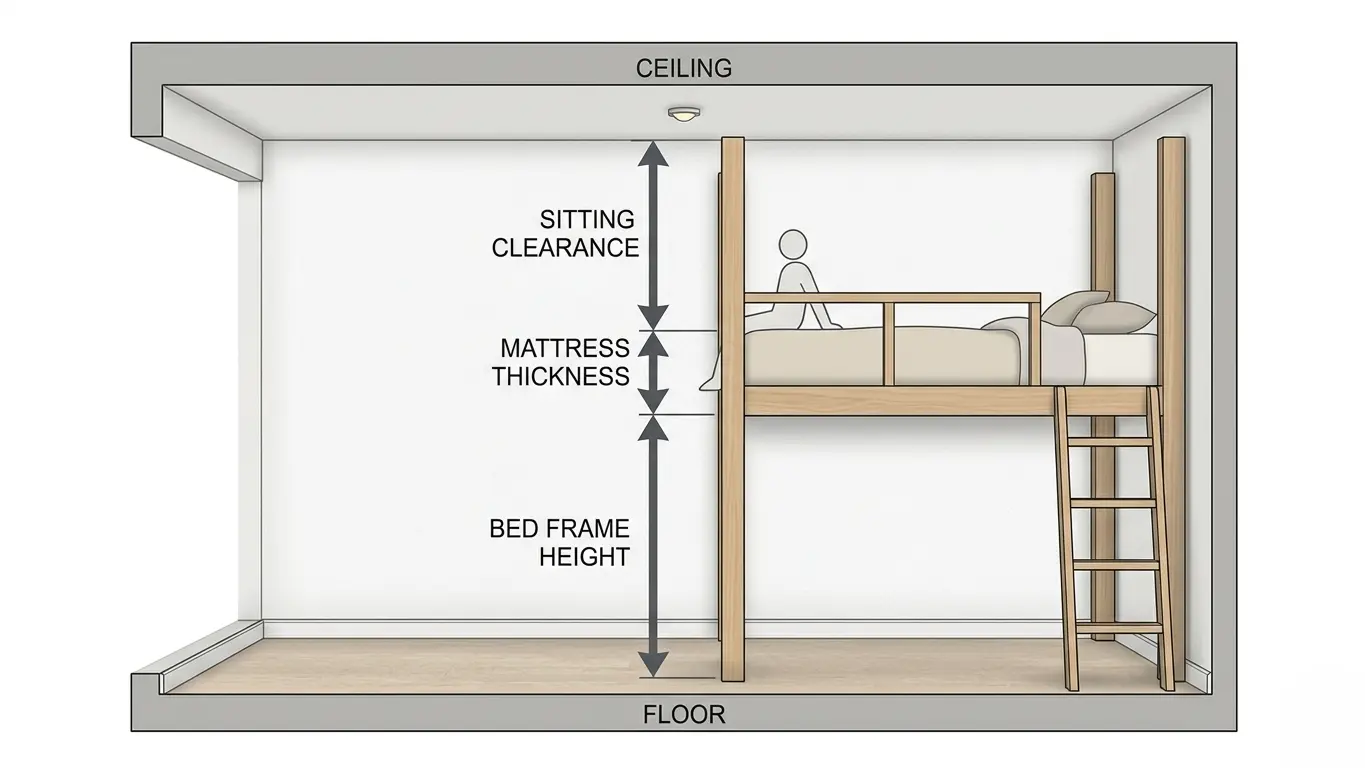
Ceiling height is the question most people forget to check until after the bed arrives. Then they put it together, climb up for the first time, and realise they can’t sit up without their head touching the ceiling. Returning a fully assembled loft bed is not a good afternoon.
The calculation is straightforward once you know the three numbers involved. Here’s exactly how to work it out, with verified figures from the US Consumer Product Safety Commission and real examples so you can check your room before you order anything.
The three numbers you need
Working out whether your ceiling is high enough comes down to adding three measurements together and checking that the total is less than your actual ceiling height. Get all three wrong and you’re in trouble. Get them right and the rest is just arithmetic.
The loft bed frame height. This is the distance from the floor to the top of the sleeping platform, not including the mattress. It’s listed in the product dimensions for every loft bed. Standard adult loft beds typically have an overall frame height of 60 to 75 inches, or roughly 152 to 190 centimeters, though this varies between models. Always check the specific product listing rather than assuming.
The mattress thickness. This sits on top of the platform. Most loft bed manufacturers recommend a mattress no thicker than 8 inches on the upper platform, which is around 20 centimeters. A thicker mattress raises your sleeping surface higher and reduces the clearance above you. Some product listings specify a maximum recommended mattress thickness, so check before buying your mattress separately.
The sitting clearance above the mattress. This is the gap between the top of your mattress and the ceiling. The US Consumer Product Safety Commission recommends a minimum of 30 inches, or 76 centimeters, of clear space above the mattress on a loft or bunk bed. For adults who use the bed daily, most people find anything above 33 inches noticeably more comfortable, particularly if you tend to sit up to read or use a phone before sleeping.
Add those three figures together and you get the minimum ceiling height you need. If your room’s ceiling is higher than that total, you’re fine. If it’s lower, that specific bed and mattress combination won’t work in your room.
The calculation at a glance
| Component | Typical measurement | Source / Notes |
| Loft bed overall frame height | 60 to 75 inches (152 to 190 cm) | Varies by model. Always check your specific product listing |
| Mattress thickness | 6 to 8 inches (15 to 20 cm) | Most loft bed manufacturers recommend 8 inches maximum on the upper platform |
| Minimum sitting clearance above mattress | 30 inches (76 cm) | CPSC minimum recommendation for loft and bunk beds |
| Comfortable sitting clearance for adults | 33 inches or more (84 cm+) | Recommended range for adult daily use |
| Minimum ceiling height needed | Frame height + mattress + clearance | Add all three figures together and compare to your room |
All clearance figures above are based on CPSC recommendations for loft and bunk beds. Frame heights are based on typical adult loft bed dimensions across major manufacturers.
A worked example with real numbers
Say you’re looking at a loft bed with a frame height of 70 inches and you want to use a standard 8 inch mattress. You want the CPSC minimum of 30 inches of sitting clearance.
70 inches (frame) + 8 inches (mattress) + 30 inches (clearance) = 108 inches total.
That’s 9 feet exactly. So you need at least a 9 foot ceiling for that specific setup at the CPSC minimum. A standard 8 foot ceiling (96 inches) would leave you 12 inches short.
Now the same frame with a 6 inch mattress and the more comfortable 36 inches of clearance: 70 + 6 + 36 = 112 inches, or just over 9 feet 3 inches. For most people in a 9 foot room that works comfortably.
A lower-profile frame at 62 inches with a 6 inch mattress and 30 inches of clearance: 62 + 6 + 30 = 98 inches, just over 8 feet. That’s a setup that works in a standard 8 foot room, but only just. There’s no room for error.
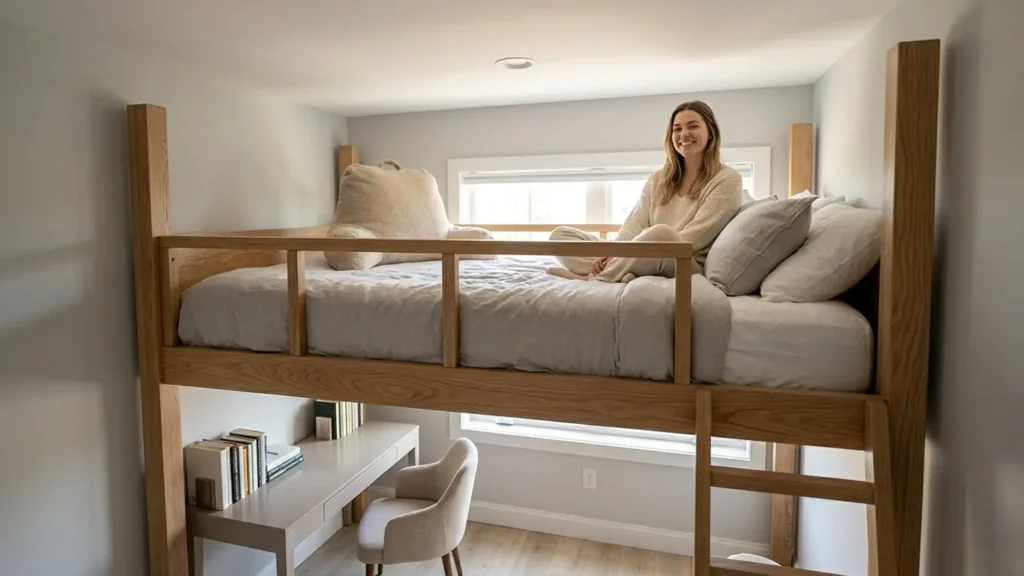
Ceiling height suitability at a glance
| Ceiling height | Loft bed suitability | Notes |
| Under 8 ft / 244 cm | Not suitable | Too low for a safe, comfortable adult loft bed setup |
| 8 ft / 244 cm (96 inches) | Possible but tight | Works with a lower-profile frame and a thin mattress. Clearance will be at or near the CPSC minimum of 30 inches |
| 8.5 ft / 259 cm (102 inches) | Workable | More flexibility than an 8 ft ceiling. Choose frame and mattress carefully |
| 9 ft / 274 cm (108 inches) | Good | Comfortable for most adults with a standard setup. The practical sweet spot |
| 9.5 ft / 290 cm (114 inches) | Very good | Plenty of clearance. Flexibility on frame height and mattress thickness |
| 10 ft / 305 cm (120 inches) and above | Excellent | No meaningful constraints. Works with virtually any adult loft bed |
Note: figures assume a standard adult loft bed frame height of around 68 to 70 inches with a mattress of 6 to 8 inches. Your specific bed may differ. Always calculate using your actual product dimensions.
Typical ceiling heights by country
Knowing your minimum requirement is only useful alongside knowing what you’re working with. Here’s what typical ceiling heights look like across the main countries our readers are in.
United States
The International Residential Code sets a minimum habitable room ceiling height of 7 feet, or 213 centimeters, though most homes are built considerably higher. Standard US homes built in recent decades typically have 8 foot ceilings in bedrooms. Newer builds increasingly use 9 foot ceilings, particularly in main living areas. Older apartments and urban buildings can run lower than 8 feet in some cases.
The practical implication: in a standard 8 foot room a loft bed is possible but needs careful product selection. A lower-profile frame, a thin mattress, and accepting the CPSC minimum clearance of 30 inches. A 9 foot ceiling gives you a genuinely comfortable setup with more flexibility.
United Kingdom
UK building regulations set a minimum ceiling height of 2.3 metres, roughly 7 feet 6 inches, across at least 75 percent of the floor area in new builds. The London Plan sets a higher minimum of 2.5 metres for new housing in the capital. Most modern UK homes are built with ceilings around 2.4 metres, or about 7 feet 10 inches. Older Victorian and Edwardian houses often have higher ceilings of 2.7 metres or above, which gives considerably more flexibility.
Australia and Canada
Both countries follow similar residential standards. Typical ceiling heights in modern builds run between 2.4 and 2.7 metres, roughly 8 to 9 feet. Newer builds at the higher end are well suited to loft beds. Older apartments at the lower end need the same careful calculation as UK flats.
Things that affect your actual clearance
Coving, beams and light fittings
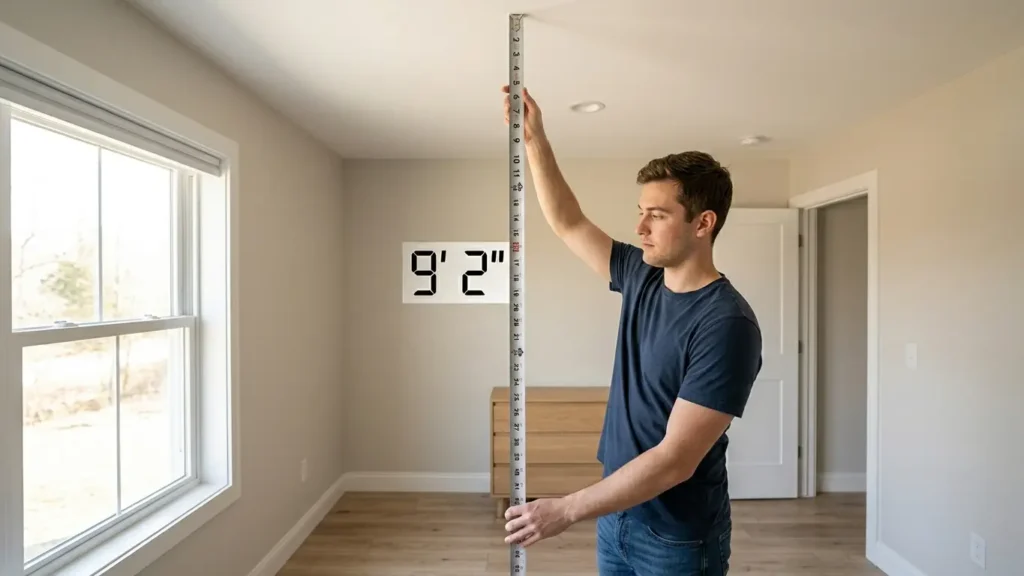
Your tape measure should go from the finished floor to the flat ceiling surface, not to decorative coving around the edges, not to exposed beams, and not to the lowest point of a recessed light fitting. If you have a beam or fan directly above where the sleeping platform will sit, measure to that instead. That’s your actual clearance limit.
Sloped ceilings
A sloped or pitched ceiling, common in loft conversions and attic rooms, changes the calculation significantly. The highest point might be adequate but if the slope runs over the sleeping platform the clearance reduces as you move toward the lower edge. Position the sleeping platform under the highest section of the slope and measure from directly above it.
Mattress compression
A new mattress will be at its full listed thickness. Over time most mattresses compress slightly, which actually increases your clearance marginally rather than reducing it. It’s not something to plan around, but it means your initial measurement is the tightest it will ever be.
The guardrail doesn’t affect ceiling clearance
The guardrail sits alongside the sleeping platform, not above it. It doesn’t reduce your ceiling clearance at all. The relevant measurement is from the top of your mattress surface to the ceiling, which is unaffected by guardrail height.
What to do if your ceiling is borderline
If the numbers put you within a few inches of the minimum, a couple of adjustments are worth trying before giving up on a loft bed entirely.
Look for a lower-profile frame. Platform heights vary between models. Some adult loft beds have frames at 60 to 62 inches rather than 70 to 75. Those extra inches make a real difference in a tight room. Check the product dimensions carefully for each specific model rather than assuming they’re all similar heights.
Use a thinner mattress. A 6 inch mattress instead of an 8 inch one gives you back 2 inches of clearance. That’s meaningful when you’re working right at the minimum. Many loft bed manufacturers specifically recommend thinner mattresses on the upper platform for this reason, and a good quality 6 inch mattress is perfectly comfortable for most adults.
Test the clearance before you order. If your calculation gives you exactly 30 inches of clearance, sit on a surface that puts you 30 inches below your ceiling and see how it feels. A table, a kitchen counter, whatever gets you to that height. It’s a quick way to check whether the CPSC minimum is liveable for you day to day before committing to a purchase.
The ceiling height question feels complicated until you sit down and do the actual calculation. Measure your ceiling, find the frame height and mattress thickness in the product listing, add your preferred clearance, and compare. If the numbers work, you’re fine. If they don’t, either find a lower-profile frame or adjust your mattress choice.
If you’ve confirmed your room works and you’re now thinking about which specific loft bed to buy, our guide to the best loft beds for small spaces covers the top picks with frame heights included for each one.
And if you’re still working out how to set up the space underneath once you have the bed, our article on loft bed ideas covers the different configurations worth considering.
The Consumer Product Safety Commission publishes the official US guidelines for loft and bunk bed safety, including the clearance figures referenced in this article.