
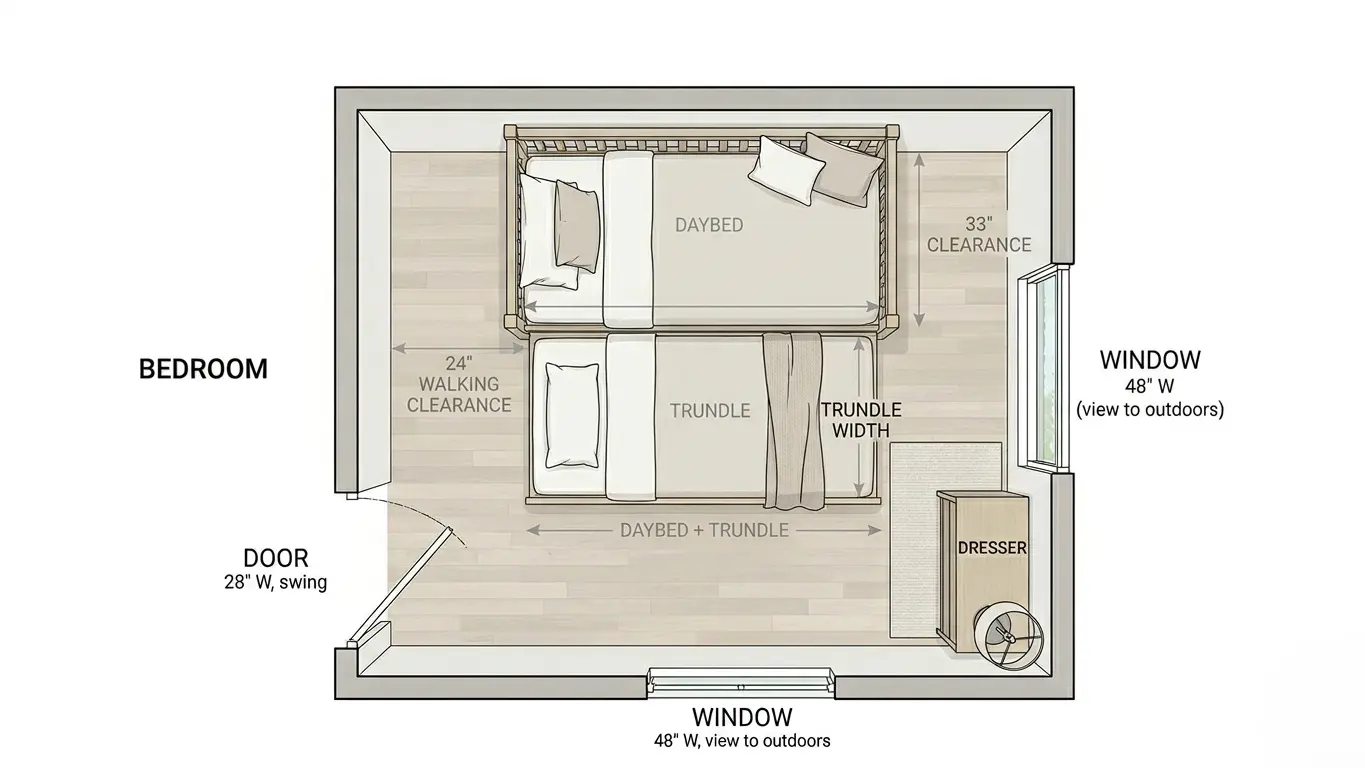
A daybed with trundle is one of the more practical furniture choices for a small room, right up until you realise after delivery that the trundle has nowhere to go when you pull it out. Getting the measurements right before ordering is the one check that prevents that problem entirely.
This article covers the exact measurements you need, the minimum room sizes that work, and the things most people overlook when planning the layout.
The three measurements that matter
Working out whether a daybed with trundle fits your room comes down to three numbers. Get all three and the rest is straightforward arithmetic.
1. The daybed footprint
This is the length and width of the main daybed frame. Most twin daybeds are approximately 77 to 82 inches long and 38 to 42 inches wide. Always check the specific product listing rather than assuming, since dimensions vary between models and brands.
The daybed will typically sit against a wall. The width of the frame is what determines how far it projects into the room. A 42 inch wide daybed projects 3.5 feet from the wall, which is meaningful in a small room.
2. The trundle extension
This is the dimension most people forget. When the trundle pulls out, it extends beyond the main daybed footprint and needs clear floor space to sit in. The trundle typically extends to the long side of the daybed, running the full length of the frame.
The trundle itself is usually slightly narrower than a standard twin, around 38 inches wide, to allow it to slide under the main frame. When pulled out it occupies an additional 38 to 42 inches of floor space beyond the main daybed width.
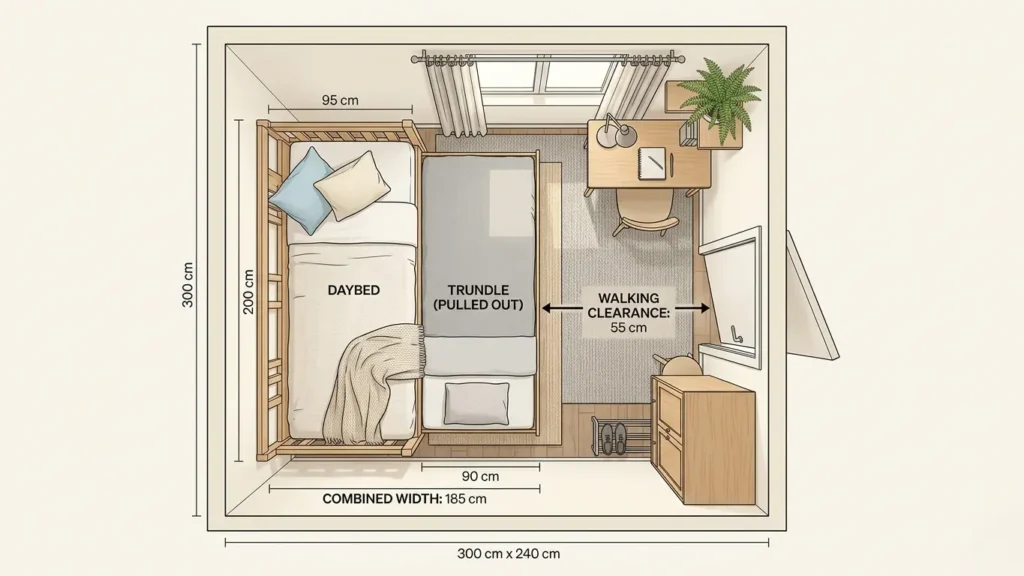
So the combined width when the trundle is in use is the daybed width plus the trundle width, roughly 38 to 42 inches plus another 38 to 42 inches, totalling around 76 to 84 inches or about 6.5 to 7 feet of combined width from the wall.
3. Walking clearance
Standard interior design guidance recommends at least 24 inches of clearance around furniture for comfortable movement, and 30 to 36 inches is more comfortable for daily use. You need this clearance on at least one side of the combined daybed and trundle footprint when the trundle is in use.
In practice this means the room needs to accommodate the wall, the daybed width, the trundle width, and the walking clearance beyond it. At the tighter end that’s around 42 plus 42 plus 24 inches, or about 9 feet of total width from the wall to the far edge of the usable space.
Minimum room sizes at a glance
| Room width | Daybed only (no trundle in use) | Daybed with trundle extended |
| 8 feet / 96 inches | Works comfortably | Tight but possible with 24 inch clearance |
| 9 feet / 108 inches | Comfortable | Works well with 30 inch clearance |
| 10 feet / 120 inches | Very comfortable | Comfortable with generous clearance |
| Under 8 feet | Possible with narrow frame | Not recommended |
Note: figures above assume a standard twin daybed approximately 42 inches wide with a trundle of similar width. Always verify your specific product dimensions before using these as a guide.
Which direction does the trundle pull out?
This is the detail that catches most people out. A trundle almost always pulls out from the long side of the daybed, not the end. That means the clearance you need is on the side of the daybed that faces the room, not at the foot of the bed.
If the daybed is positioned with the long side against a wall and the foot end pointing into the room, the trundle still pulls out from the long side, which means it pulls out toward the opposite wall rather than toward the open space at the foot. In many small room layouts this creates a problem that isn’t obvious until you actually try to use the trundle.
Before finalising the bed position, check the product listing specifically for which direction the trundle extends. Some daybeds, particularly corner designs, have different pull-out configurations. If the listing doesn’t specify, contact the seller before ordering.
Room layout scenarios
Daybed against a single wall, room open on three sides
The most straightforward layout. The daybed sits against one wall with the long side facing the room. The trundle pulls out toward the open room space. As long as the room width from that wall to the opposite wall is at least 9 feet, the trundle can extend fully and leave 30 inches of walking clearance. This is the layout most daybed with trundle setups are designed around.
Daybed in a corner
A standard daybed in a corner, with one short end against a side wall, limits the trundle to pulling out toward the open side of the room only. The side wall blocks the trundle on one side. This works fine as long as the open side has enough clearance, but it means the room layout needs to account for that single direction of extension rather than having flexibility.
A corner daybed, designed specifically to sit in a corner with panels on two sides, is a different product with its own layout logic. These don’t typically include a trundle, instead using the corner space for storage drawers underneath.
Small guest room or studio
In a studio or small guest room where the daybed serves as the primary furniture piece, the trundle layout often works well because the room doesn’t have other furniture competing for the floor space the trundle needs. The daybed sits against one wall, the central floor area stays clear during the day, and the trundle pulls out into that space when a guest arrives.
The constraint in a studio is that the trundle needs clear floor space that isn’t occupied by a coffee table, a rug with furniture on it, or other pieces. If the area in front of the daybed is furnished, there needs to be a plan for moving things before the trundle comes out.
Before you order, measure these things
Room width from the intended wall to the opposite wall. Add the daybed width plus the trundle width plus your preferred walking clearance and check it fits within this measurement.
Door and hallway width. A daybed frame is a large piece of furniture. Check the product dimensions against your front door and any internal hallways or turns the frame needs to navigate on delivery. Many daybed frames ship in multiple boxes, which helps, but it’s worth confirming before ordering.
The floor space in front of the intended daybed position. Stand in the room and picture the trundle fully extended in front of the daybed. Is there anything in that zone that can’t be moved? A radiator, a built-in wardrobe door swing, a window sill? These constraints don’t show up in floor plan sketches but they matter when the trundle is actually in use.
The specific product dimensions. Don’t use general twin bed dimensions as a proxy. Check the actual length, width and trundle extension for the specific model you’re ordering. Products vary and a few inches either way can be the difference between a comfortable layout and an awkward one.
Once you’ve confirmed the room works and you’re ready to look at specific options, our guide to the best daybeds with trundle for small rooms covers the top picks with dimensions included for each one so you can match them against your room measurements directly.
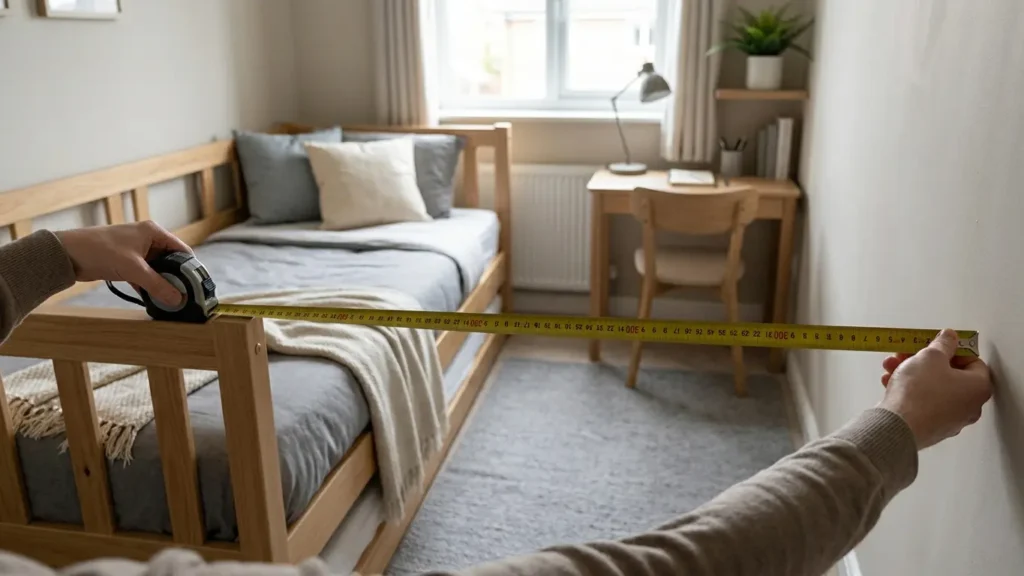
Getting furniture dimensions right in a small room is one of those things that feels tedious until you get it wrong. Measure the room, the doorways, and the path from your front door to the final position before you order anything, not after the delivery van has left.