
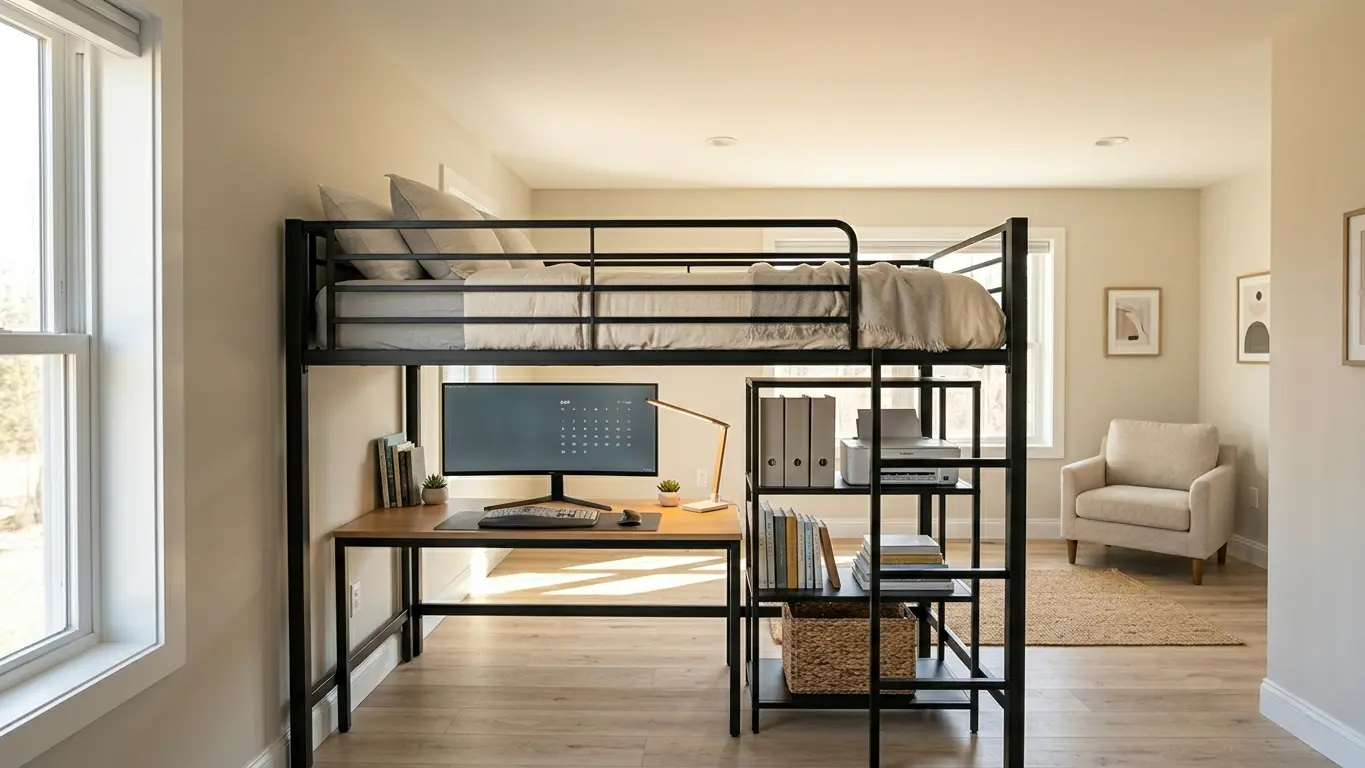
The space underneath a loft bed is the whole point. It’s the reason you chose a raised frame over a standard bed in the first place. But a surprising number of people put the bed together, look at the open space below, and then just leave it empty or fill it with things they haven’t found a proper home for.
That space deserves more thought. Depending on how you set it up, the floor beneath a loft bed can function as a home office, a wardrobe, a reading corner, or simply open floor space that makes a room feel twice as big as it actually is. Here’s how to think through the options and set it up in a way that actually suits how you live.
Start with how you actually use the room
Before deciding what goes underneath, it helps to be honest about how you use the space. Not how you’d like to use it, how you actually use it day to day.
If you work from home, a proper desk setup is probably the most valuable thing you can put under there. If you don’t have a wardrobe in the room, built-in or free-standing clothes storage solves a real daily problem. If the room is large enough that you don’t need to reclaim every square inch, leaving the space open gives the room breathing room that makes it feel considerably less like you’re living inside a piece of furniture.
The worst outcome is setting up something that sounds good in theory but doesn’t match how you actually live. A reading nook sounds appealing, but if you never read in your room it’ll just become somewhere to pile things. A minimalist open floor plan sounds good until you realise you have nowhere to put your clothes.
Pick the function that solves your actual biggest problem first. Everything else follows from that.
The home office setup
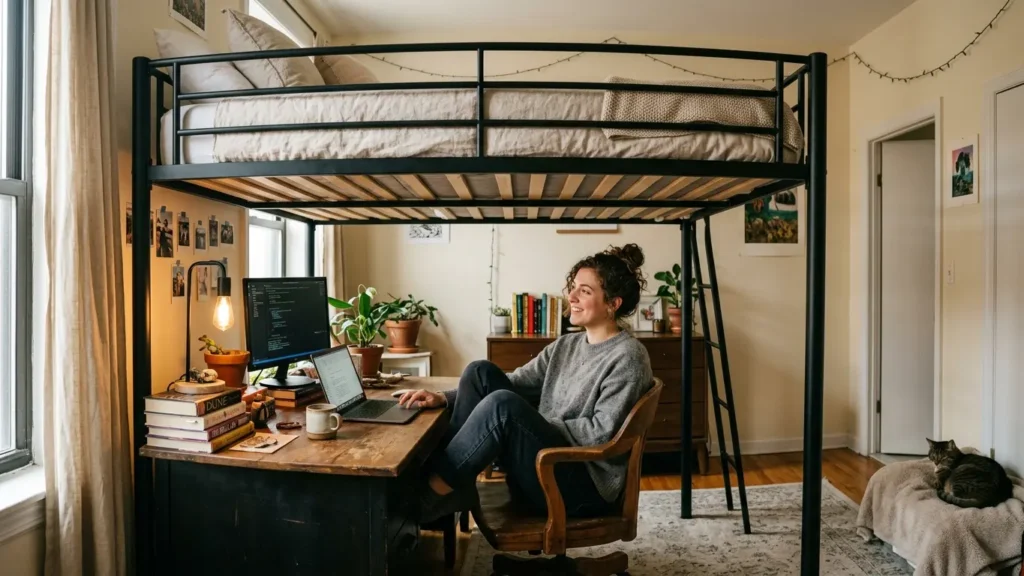
This is the most popular configuration for a reason. A loft bed with a desk underneath gives you a dedicated workspace without sacrificing a separate room for it. For anyone working from home in a studio or one-bedroom apartment, that’s genuinely valuable.
Built-in desk vs freestanding
Some loft beds come with a desk built into the frame, usually in an L-shape or U-shape that wraps around the corner. These are convenient since everything arrives as one unit, and the desk is designed to fit the space perfectly. The trade-off is that the desk is part of the frame and can’t easily be repositioned.
A freestanding desk placed underneath a basic open-frame loft bed gives you more flexibility. You can choose the exact desk size and configuration you want, move it if you change your mind, and upgrade it independently of the bed. If you already have a desk you like, this approach makes sense.
The under-bed clearance on most adult loft beds is enough for a standard desk and a seated person. The key measurement is the height from the floor to the underside of the sleeping platform, which typically runs between 55 and 60 inches on adult models, more than enough for a desk, a monitor, and a chair.
Making it feel like a proper workspace
The space underneath a loft bed can feel enclosed, which some people find focused and others find claustrophobic. A few practical things help.
Good task lighting matters more here than in an open room since you’re working under a platform that blocks overhead light. A decent desk lamp pointed at your working surface makes the space feel considerably more comfortable than trying to work under a dim ceiling light that the bed frame is blocking.
Cable management is worth thinking about from the start. Running cables along the bed frame and down a back corner keeps the workspace looking clean rather than like a nest of wires. A small cable tray attached to the underside of the platform keeps everything out of sight.
If the space feels too enclosed, a light-coloured wall behind the desk helps. Dark walls in an already partially enclosed space amplify the cave feeling. Light reflects better off pale walls and makes the space feel more open.
The wardrobe and clothing storage setup
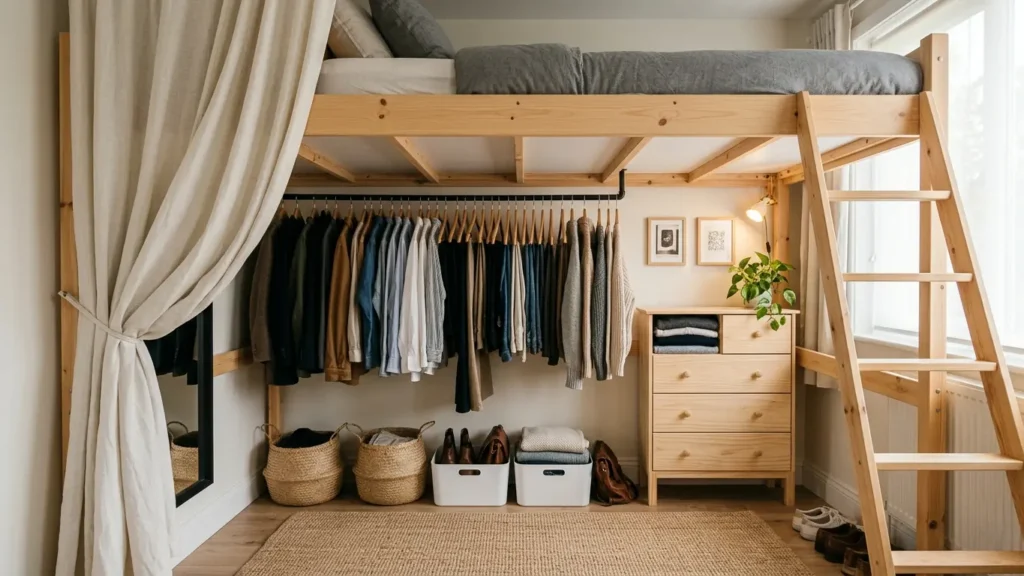
If your room doesn’t have built-in wardrobe space, the area under a loft bed is a practical place to solve that problem. Some loft beds come with a built-in wardrobe section as part of the frame, which handles this automatically. If yours doesn’t, a freestanding wardrobe or a combination of a hanging rail and a chest of drawers fits comfortably in most under-bed spaces.
A hanging rail with a curtain in front of it is the simplest version. It keeps clothes accessible, keeps them out of sight, and takes up minimal floor space since there’s no door swing to account for. A freestanding open wardrobe, the kind with a hanging rail and a few shelves, works well if you prefer everything visible and accessible without the curtain.
The advantage of using this space for clothing storage is that it consolidates everything in one area of the room. Your sleeping space is up top, your clothes are directly below. You don’t need to walk to a separate wardrobe corner and the room has more open space elsewhere.
The reading or relaxation corner
If your desk is elsewhere and you don’t need wardrobe space, a small seating area underneath a loft bed is a genuinely pleasant setup. A compact armchair or a two-seater sofa, a small side table, a lamp, and a few books. It creates a naturally separate zone within the room that feels different from the sleeping space above it.
The enclosed feel of being underneath a raised platform actually works in your favour here. It creates a sense of being in a defined space rather than just sitting in the middle of a room. Some people find it a more comfortable reading environment than an open chair in the corner of a room.
The practical constraint is ceiling clearance on the lower side. If your loft bed has a staircase rather than a ladder, the staircase takes up floor space on one side. Factor that into the layout before choosing your seating.
Leaving it open
This is an underrated option that doesn’t get enough consideration. If the room is large enough, or if you simply don’t have an immediate function in mind for the space, leaving the area under the loft bed completely open is a valid and often smart choice.
An open floor plan under a raised bed makes the room feel larger than it is. Your eye sees the open space and the raised sleeping area above it as two distinct zones rather than one cramped room. Interior designers consistently point to vertical thinking, drawing the eye up rather than across, as one of the most effective ways to make a small room feel bigger without changing anything structural.
You can always add function later. A yoga mat rolled out underneath for morning exercise. A suitcase stored there when not in use. A folding table brought out when you need a workspace. The open space is flexible in a way that a fully fitted desk setup isn’t.
Practical things that apply to all setups
Lighting
The underside of a loft bed blocks ceiling light from reaching the space below. Whatever you put underneath, plan for additional lighting that doesn’t rely on the overhead. LED strip lights attached to the underside of the platform are a clean and inexpensive solution that light the space evenly without cables running across the floor. A freestanding lamp works well for a reading corner. A task lamp is fine for a desk.
Keeping it from feeling enclosed
Light wall colours, mirrors, and keeping the front of the under-bed space open rather than surrounded on three sides all help with this. If the bed is against a wall, you have two sides enclosed already. Keep the remaining sides open and make sure there’s enough light in the space that it doesn’t feel like a cupboard.
Storage on the sleeping platform
The space directly under the mattress and above the desk or wardrobe, the platform itself, is sometimes used for additional storage. Bed rails with integrated shelving, a shelf at the head of the platform for books and a phone, and a bedside pocket for essentials all make the sleeping area more functional without affecting the space below. Keep it minimal up there though. The more you pile onto the platform, the more the sleeping space starts to feel cramped.
What if you want the storage without the height?
A loft bed is the right call when you need the floor space underneath for something functional, a workspace, a wardrobe, an open area. But if your main goal is storage and you don’t need a usable floor area, a storage bed is a different kind of solution worth considering.
An ottoman bed keeps the sleeping surface at normal height and uses the space underneath the mattress as a large enclosed storage compartment, typically enough for spare bedding, seasonal clothing and anything else you want out of sight. It’s a cleaner look in a room where a raised sleeping platform doesn’t suit the space, and the storage capacity is genuinely substantial.
We cover the best options in our guide to the best ottoman beds for small apartments, if that’s a direction worth exploring alongside or instead of a loft bed.
The space underneath a loft bed is what you make of it. The bed gives you the floor back. What you do with that floor is the more interesting question, and the answer is different for everyone depending on how they actually live.
If you’ve worked out how you want to set up the space underneath and you’re ready to look at specific beds, our guide to the best loft beds for small spaces covers the top picks across styles and budgets — including options with built-in desks and open-base frames you can furnish yourself.”
Thinking vertically, drawing the eye and the function of a room upward rather than spreading everything out across the floor, is one of the most consistently effective approaches to making a smaller space work well.