
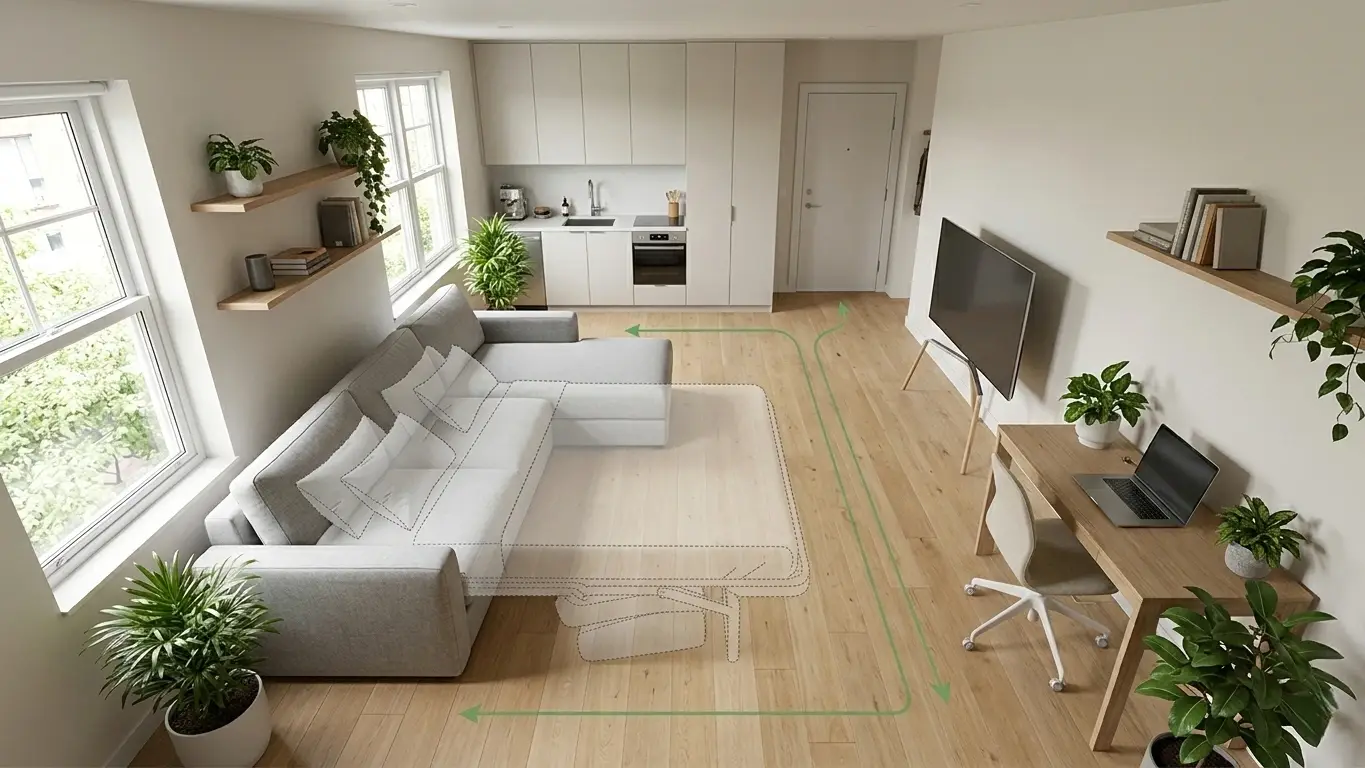
Arranging a sofa bed in a studio apartment is not just about where it looks good. It is about where it actually works when you open it up at 11pm after a long day, without having to shift three pieces of furniture out of the way first.
I have seen layouts that looked great as sofas and were completely unusable as beds. A coffee table that could not be moved easily. A rug too heavy to shift. A position that made perfect sense for watching TV and made zero sense for sleeping.
Here is what actually works, and a few things that seem reasonable until you actually live with them.
Start with the bed open, not the sofa closed
This is the single most important thing. Most people arrange their studio around how the sofa looks closed. Then they pull out the bed for the first time and realise they cannot open it fully without hitting the wardrobe door, or that it extends directly into the kitchen walkway, or that there is literally no way to walk around it.
Before you decide on a position, open the bed completely. Stand next to it. Walk around it. Check every exit from the room. If something does not work in bed position, no amount of clever sofa styling is going to fix it.
This sounds obvious. Almost nobody does it.
Against the wall is almost always right
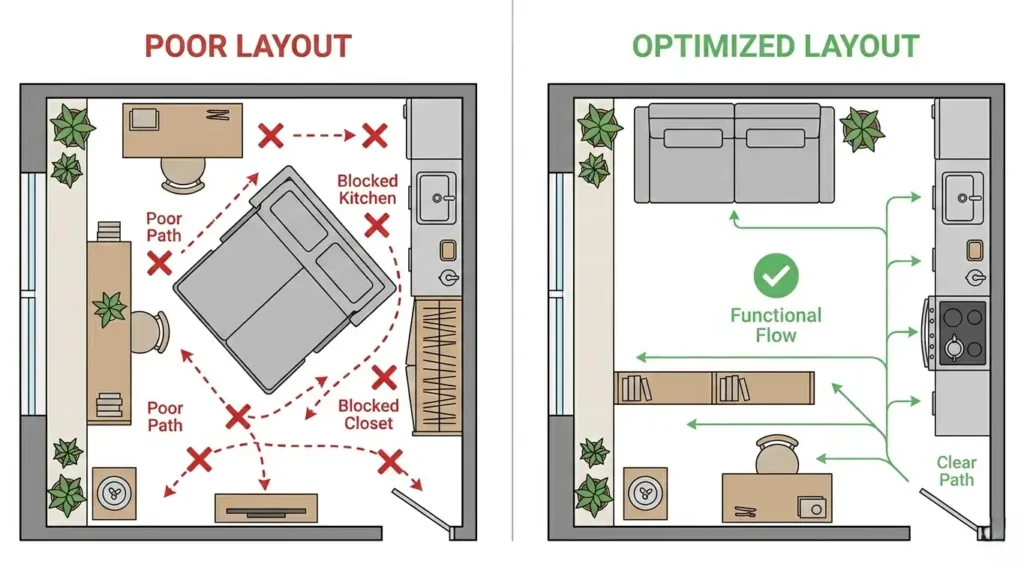
Put the sofa bed against the longest available wall. This keeps the floor space in front open during the day and gives the bed somewhere to extend into at night.
Floating the sofa in the middle of the room might look interesting on a mood board but in a studio it creates chaos. There is no clear direction for the bed to extend, you lose usable floor space on all sides, and the room feels like you moved in last week and have not finished unpacking yet.
The wall gives the furniture a home. The center of the room stays open. That is the arrangement that makes a studio feel like a proper living space rather than a storage unit you also sleep in. If you are considering a corner sofa bed specifically, which uses two walls rather than one, our guide on corner sofa beds for small living rooms covers exactly how to make that layout work.
Define zones without adding bulk
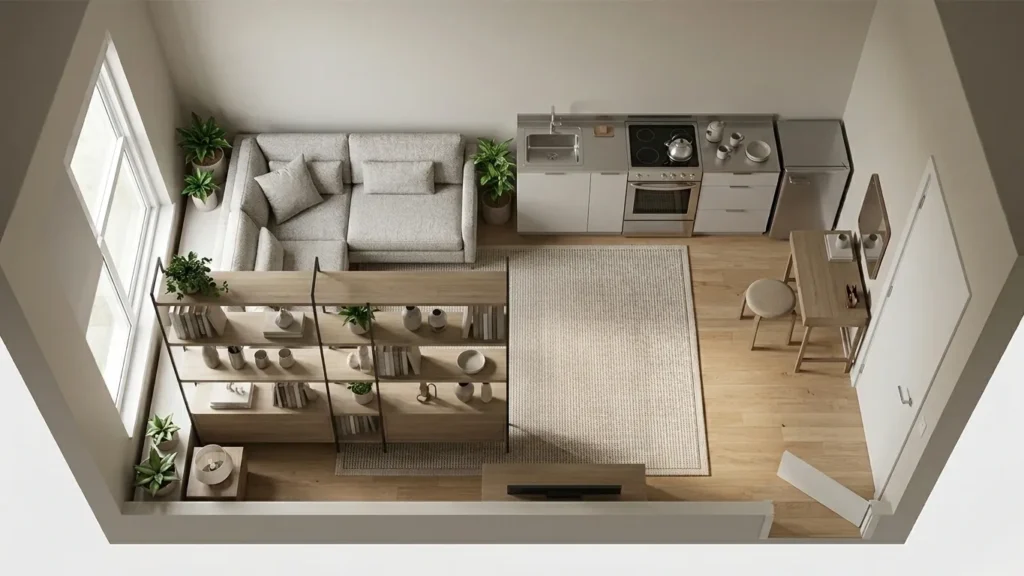
A studio with a sofa bed needs zones, even if they are entirely visual. A sleeping and sitting area in the same spot with nothing separating them just looks like a mess.
You do not need walls or heavy dividers to create zones. A rug under the sofa bed area signals this is the living space. A floor lamp at one end of the sofa marks where the seating zone ends. A narrow console table or a bookshelf behind the sofa, if the back of it is visible, creates a soft boundary between the living area and whatever is behind it.
These cost very little and make the room feel intentional. The difference between a studio that feels like someone designed it and a studio that just feels small is usually this kind of detail.
The coffee table situation
Every studio sofa bed layout needs a plan for the coffee table, because when the bed opens, the coffee table needs to go somewhere.
The options that actually work:
- A lightweight table you can slide out of the way easily. Not a heavy solid wood one, not one with a heavy marble top. Something you can move in under ten seconds with one hand.
- Nesting tables. Two or three small tables that slide together and can be pushed aside individually. Very practical for small spaces.
- An ottoman with storage. Acts as a coffee table during the day and can be pushed to the side or used as a step to get onto the bed at night. The storage inside is a bonus.
- No coffee table at all. Genuinely underrated in a very small studio. A side table at the end of the sofa does most of what a coffee table does without sitting directly in the bed’s path.
What does not work: a large fixed coffee table that requires two people to shift, placed directly in front of a pull-out sofa. You will move it every single time you use the bed. After the third time, you will start wondering why you bought the coffee table at all.
Leave clearance in front, always
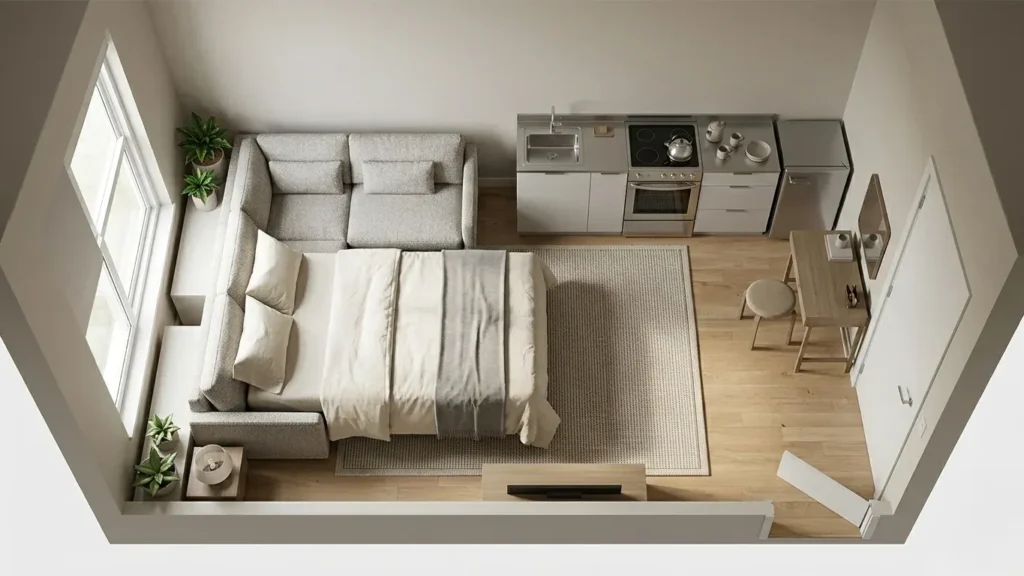
A pull-out sofa bed needs clear floor space in front of it. Not sort of clear. Actually clear. No rugs that catch on the frame, no side tables too close to the centre, no floor lamp positioned where the mattress lands.
The minimum is around 85 to 95 inches of depth from the wall to the far edge of the open mattress, depending on the model. Add 24 inches of walking clearance beyond that if there is anything in that direction. That is roughly 9 to 10 feet of total floor depth needed in the direction the bed extends.
If the room does not have that in the right direction, move the sofa to a wall where it does. Not every wall works. Measure before you decide, not after delivery.
If you are not sure what size sofa bed works in your specific room, our guide on what size sleeper sofa fits in a small apartment has the measurements laid out clearly.
Bedding storage within reach
This one catches people out. The sofa bed needs bedding. The bedding needs to live somewhere close by, because if it is in a cupboard at the other end of the room, making up the bed every night becomes a proper chore and you will stop doing it properly.
The best options:
- An ottoman at the foot of the sofa. Open it, grab the duvet, done. Close it in the morning, shove the duvet back in. Fast and tidy.
- A storage compartment in the sofa itself. Some corner sofa beds and sectionals have this. Worth specifically looking for if storage is tight.
- A slim storage basket beside the sofa. Not glamorous but it works. Throw blanket on one side, pillows on the other, duvet folded underneath.
Keeping the bedding folded on the mattress and sliding it under with the frame also works if the sofa bed allows it. Some do, some do not. Check the mechanism before relying on this.
Light and natural positioning
Do not block your only window with a large sofa bed if you can avoid it. Natural light makes a small space feel considerably larger, and blocking it with the back of a sofa just to get a marginally better TV angle is a trade-off you will regret every morning.
Position the sofa so the window is either beside it or in front of it. Sitting on the sofa looking toward a window is much nicer than sitting in a dark corner looking at a wall. And when the bed is open, having light in the room during the day makes it feel less like you are camping in your own living room.
Mistakes that seem fine until they are not
- Placing the sofa bed in front of the wardrobe. When the bed opens it will either block the wardrobe doors entirely or come extremely close. You will find this out on the first night a guest stays and needs their bag.
- Choosing a heavy rug that the bed frame catches on. The frame needs to slide out smoothly. A thick pile rug directly in the pull-out path means wrestling the bed open every time.
- Positioning the sofa so the bed extends toward the front door. It happens more often than you would think in small studios. You cannot leave the apartment while a guest is sleeping. Awkward for everyone.
- Buying an oversized model for the room and hoping it will be fine. It will not be fine. Measure the open bed dimensions first, every time.
Once you have the layout sorted and you are ready to look at specific sofa bed options, our guide to the best sofa beds for small apartments covers the top picks with real dimensions included.
And if you are still deciding between a pull-out and a sectional for your layout, our article on whether a sectional sleeper sofa works in a studio apartment covers that specific decision.