
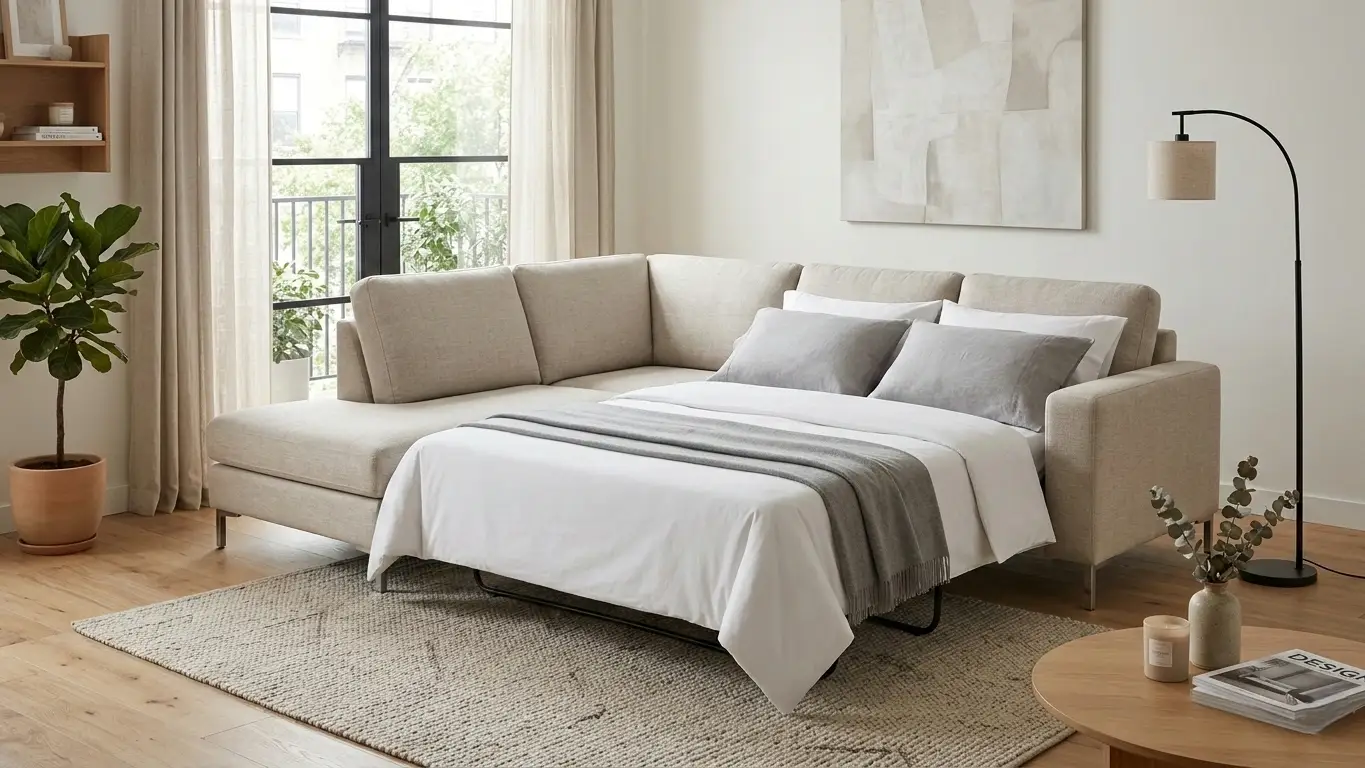
Yes, a sectional sleeper sofa can work in a studio apartment. But it is not as forgiving as a compact pull-out or a futon, and it will not work in every studio regardless of how carefully you arrange it.
The short answer depends on three things: the size of your studio, the shape of the room, and whether you are willing to treat the sectional as the centrepiece of the layout rather than just another piece of furniture.
This article covers when it works, when it does not, and what to check before you commit to something that heavy and that large.
Why people consider a sectional for a studio
A standard sofa bed gives you seating for two or three people at most. A sectional gives you significantly more seating in the same approximate footprint, because it uses corner space rather than running along a single wall.
In a studio where the living area and the sleeping area share the same space, more seating matters. A sectional makes the room feel more like a proper living room and less like a bedroom you also happen to sit in.
When the sectional also includes a sleeper, you get seating, a bed, and occasionally storage in a single piece of furniture. For someone furnishing a studio from scratch, that combination is genuinely appealing.
The space question: be honest about your room
This is where most people go wrong. They see a compact sectional sleeper sofa online, note that it fits within their budget, and order it without properly accounting for what happens when the bed is open.
A sectional sleeper sofa is larger than a standard sofa bed. The L-shape means it occupies two walls instead of one, and when the pull-out extends it needs clear floor space in the direction it opens. In a studio under 350 square feet, a full-size sectional sleeper sofa often leaves too little usable floor space to live comfortably.
Before you look at specific models, work out these three numbers for your studio:
- The length of each wall the sectional will sit against. Both sections need to fit without blocking doorways, windows, or radiators.
- The open bed depth. Most sectional pull-outs extend 85 to 95 inches from the sofa frame. Measure from where the bed will extend to the nearest obstacle.
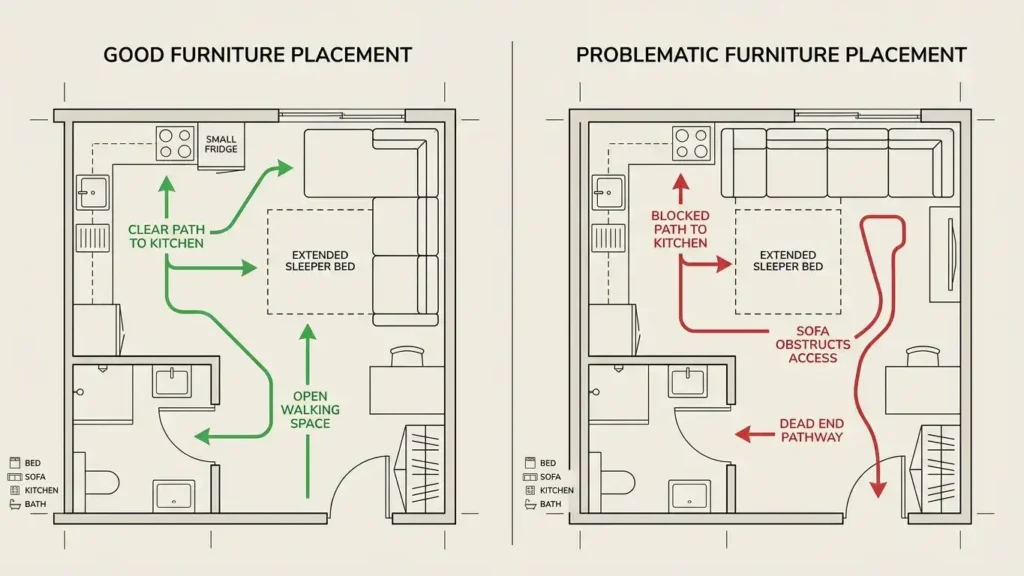
- The walking clearance when the bed is open. You need at least 24 inches of clear walkway to reach the kitchen, bathroom, and exit. Measure this in bed position, not sofa position.
If the room dimensions work on paper, it is worth proceeding. If they do not, a compact pull-out or a corner sofa bed is a more realistic option. Our guide on what size sleeper sofa fits in a small apartment covers the measurements in detail.
If a full sectional feels too large for your room but you still want the corner seating advantage, our guide on corner sofa beds for small living rooms covers a more compact version of the same approach.
Corner placement: why it makes the difference
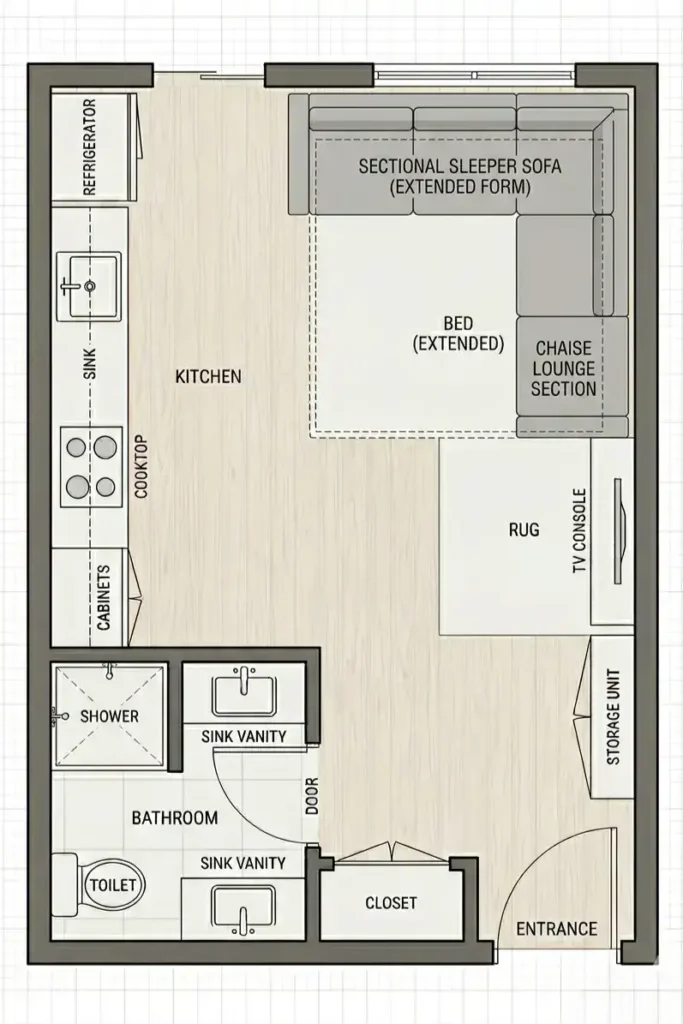
A sectional sleeper sofa placed against two walls in a corner uses space in a fundamentally different way from a sofa along a single wall. The corner anchors the furniture, defines the living zone clearly, and leaves the centre of the room open during the day.
When the bed extends, it extends into that central space rather than blocking a walkway or pushing up against other furniture. In a rectangular studio this typically works well. The sofa takes the corner, the kitchen or workspace occupies the opposite end, and the open bed sits in the middle of the room when needed.
This only works if the corner has two usable walls of sufficient length. A corner interrupted by a doorway, a large window, or a built-in wardrobe changes the geometry significantly. Check your specific corner before assuming the layout will work.
When a sectional sleeper sofa works well in a studio
There are specific situations where a sectional genuinely makes sense:
- Rectangular studios of 400 square feet or more. Enough room to absorb the sectional footprint without the space feeling overwhelmed.
- Studios with a clear corner that has two usable walls. No doorways or built-ins interrupting the corner placement.
- Studios where you host guests regularly. The extra seating a sectional provides is a genuine advantage if people visit often.
- Studios where you do not rearrange furniture. A sectional sleeper sofa is heavy and awkward to move once placed. If you like shifting things around, it will frustrate you.
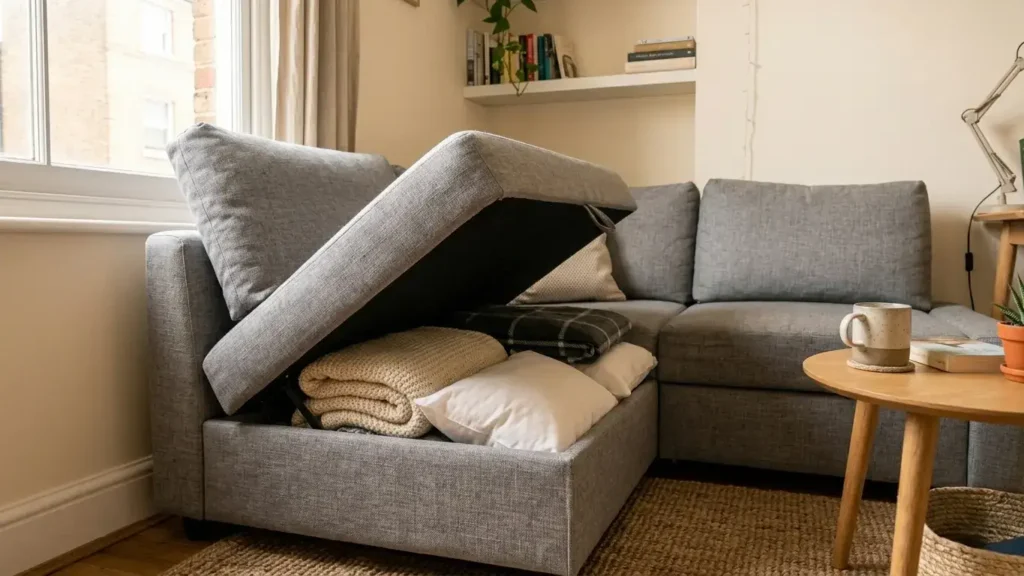
- Studios where storage is a priority. Some sectional sleeper models include storage in the chaise section. In a studio, that built-in storage removes the need for an additional storage piece.
When a sectional sleeper sofa does not work in a studio
Be honest about your room before ordering. A sectional does not work well if:
- The studio is under 300 to 350 square feet. The sectional footprint leaves too little room to live in. A compact pull-out or futon is the more practical answer at this size.
- The bed extension blocks the kitchen or bathroom path. Always measure this specifically. It is the most common layout mistake with sectional sleeper sofas in small spaces.
- You move frequently. Sectional sleeper sofas are among the heaviest pieces of residential furniture. Moving one up a flight of stairs is not a casual undertaking.
- The room is an irregular shape. L-shaped rooms, rooms with alcoves, or rooms with multiple doorways often do not have a clean corner for the sectional to sit in.
Sectional sleeper sofa vs standard sofa bed in a studio
| Factor | Sectional sleeper sofa | Standard sofa bed |
| Floor space | Uses corner, more efficient for seating per sq ft | Uses single wall, simpler footprint |
| Seating capacity | Higher, seats 4 to 6 typically | Lower, seats 2 to 3 typically |
| Open bed clearance | Extends into central room space | Extends forward from single wall |
| Storage options | Often includes chaise storage | Rarely includes storage |
| Weight and mobility | Heavy, difficult to move | Heavy but easier than sectional |
| Best studio size | 400 sq ft and above | 300 sq ft and above |
| Best for | Regular guests, corner layouts, storage needs | Simpler layouts, occasional guests |
What to check before ordering
- Total L-shape dimensions. Get both the length of the long section and the length of the chaise. Both need to fit against their respective walls.
- Which direction the chaise faces. Most sectionals are available in left-hand or right-hand configurations. Check which one matches your corner before ordering. Getting this wrong means the chaise blocks the wrong wall.
- The pull-out direction. Some sectional sleeper sofas pull out from the main section, others from the chaise. The pull-out direction determines which way the bed extends and what clearance you need.
- Delivery access. Sectionals usually ship in two or more pieces, which helps with doorways. Confirm this with the retailer before ordering.
- Weight capacity on the pull-out. Check this specifically. The sectional frame and the pull-out mechanism are often rated separately.
If you have decided a sectional is the right direction, our guide to the best sectional sleeper sofas for small spaces covers the top options with dimensions and configuration details included.
And if the sectional footprint feels too large for your studio, our guide to the best sofa beds for small apartments covers the full range of compact options including standard pull-outs and corner sofa beds.
For practical advice on positioning whichever sofa bed you choose, our guide on how to arrange a sofa bed in a studio apartment covers the layout decisions that make the difference between a room that works and one that does not.
For more on the pros and cons of sofa beds in general before committing to a sectional specifically, our article on sofa bed advantages and drawbacks covers the practical trade-offs across all types.