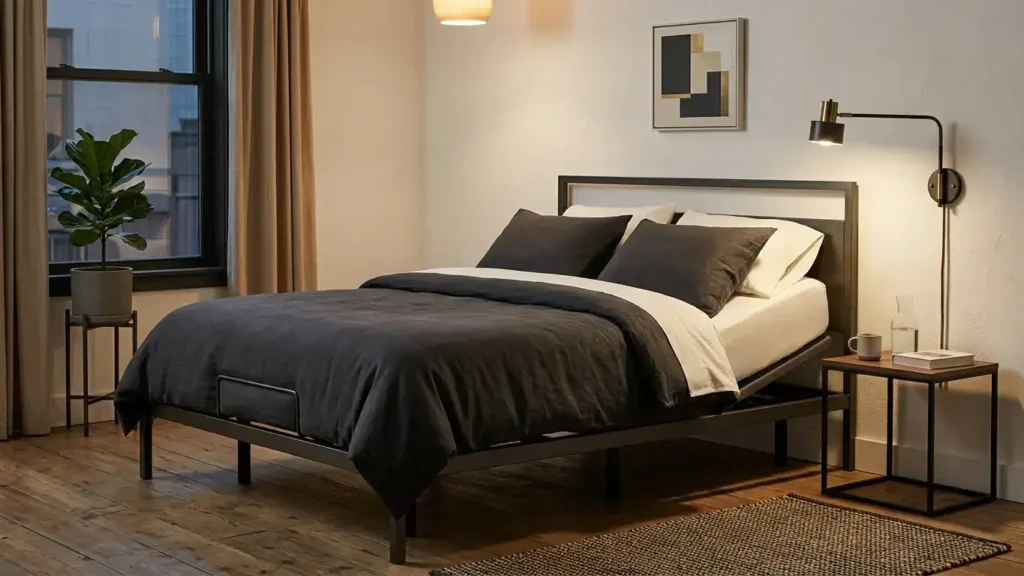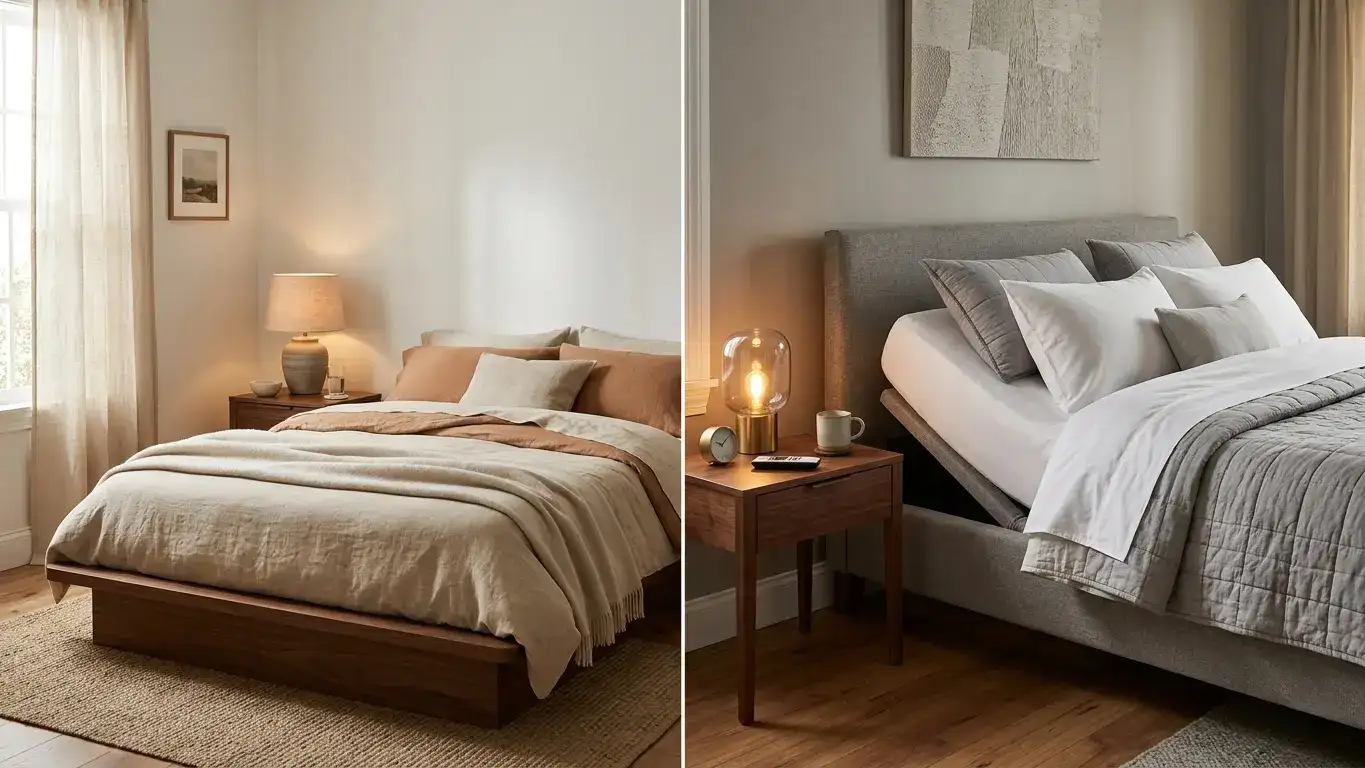
A platform bed frame does one thing. It holds your mattress at a fixed height and lets you sleep. It does that job quietly, reliably, and in almost any style you can imagine, from a low-profile wood platform bed with clean lines to a Victorian metal frame with a headboard. Most people need exactly that, nothing more.
An adjustable base does considerably more. It positions your body. It raises your head for reading or watching television. It elevates your feet to relieve pressure. Some models offer massage, zero-gravity presets, and app control. For the right person, it transforms the bedroom experience. For everyone else, it is a significant investment in features they will rarely use.
So the question is not which one is better. The question is which one your life actually calls for.
What a platform bed frame offers
A platform bed frame is a fixed surface. You choose it, you place it, and it stays exactly where it is. That simplicity is one of its genuine strengths. There are no motors to maintain, no remote controls to lose, and no moving parts to wear out. A well-built wood platform bed frame or metal platform bed frame lasts for many years without asking anything of you beyond the occasional bolt check.
Beyond reliability, platform bed frames offer design freedom that adjustable bases simply cannot match. Wood bed frames in natural pine or oak bring warmth and character to a room. Metal frames in Victorian or industrial styles make a visual statement. Upholstered frames anchor the room with softness and texture. The variety spans every aesthetic from spare minimalism to layered, lived-in comfort.
Furthermore, platform beds accommodate nearly all mattress types. Memory foam, latex, hybrid, and even traditional innerspring mattresses all work on a solid platform surface. There are no compatibility restrictions to navigate.
In a small bedroom specifically, the low profile of a platform frame keeps the room feeling open. The visual weight stays close to the floor. The ceiling reads higher. That is a genuine spatial benefit that an adjustable base, with its mechanical bulk underneath, cannot replicate in the same way.

What an adjustable base actually does
An adjustable base replaces the fixed platform with a motorised one. At the touch of a button, the head section rises, the foot section lifts, or both move together into a preset position. Entry-level models do the basics well. Premium models from brands like Tempur-Pedic, Saatva, and Sleep Number add massage zones, under-bed lighting, split-king configurations, USB charging, and zero-gravity presets that distribute body weight evenly to relieve pressure on joints and the lower back.
The health benefits for specific conditions are well documented. People who manage acid reflux sleep better with the head slightly elevated. Those with sleep apnea benefit from an inclined head position that opens the airway. Side sleepers with hip and shoulder pressure find that a combination of slight head elevation and foot lift relieves that pressure meaningfully. People recovering from surgery often find that controlled positioning makes rest more manageable during recovery.
One orthopedic perspective worth noting: for people dealing with chronic pain, poor circulation, or specific respiratory conditions, an adjustable base is not simply a comfort upgrade. It functions as a practical health tool that affects daily quality of life. That changes the conversation significantly. If any of those conditions apply to you or your partner, the price becomes less about luxury and more about what the investment actually returns.
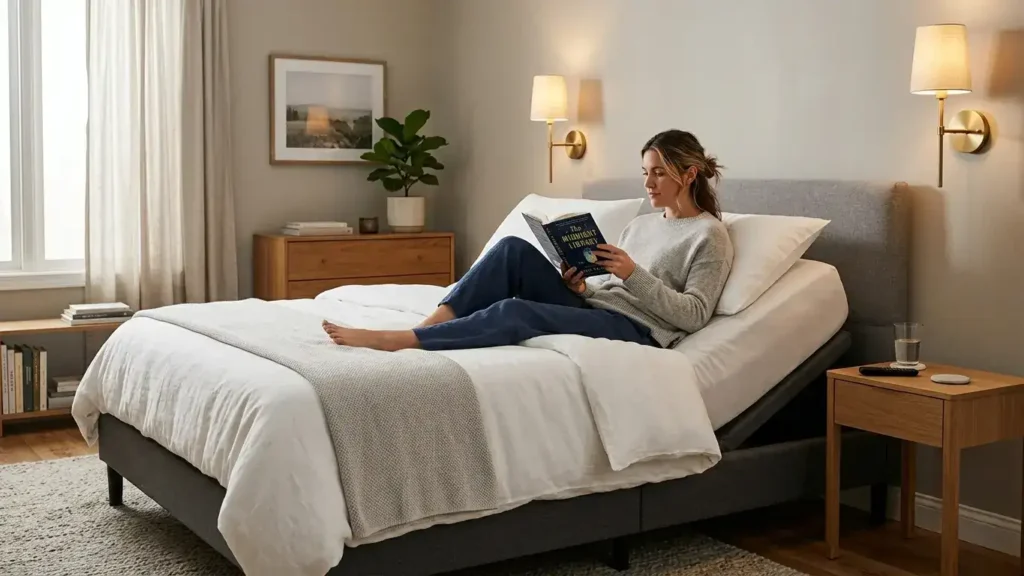
Beyond health, there is the lifestyle case. Reading in bed with the head section raised is genuinely more comfortable than stacking pillows against a headboard. Watching television from bed at a reclined angle rather than sitting upright is a different experience entirely. For people who spend meaningful time in bed beyond sleeping, that daily comfort has real value.
The honest costs and trade-offs
Adjustable bases start at around $500 for a basic motorised model and climb to $3,000 or more for premium configurations with split-king options, massage zones, and smart home integration. A king-size split adjustable base from a brand like Tempur-Pedic or Saatva can reach $5,000 to $6,000. These are not impulse purchases.
Beyond price, weight is a real consideration. A motorised adjustable base for a queen bed weighs between 150 and 200 pounds, often more than the mattress sitting on top of it. Moving an adjustable base requires disassembly or professional help. If you move apartments regularly, that weight becomes a genuine burden.
Noise is another point worth addressing honestly. Motors produce sound. On high-quality models the sound is minimal, a quiet hum as the position changes. On cheaper models it can be more noticeable. If you or your partner is a light sleeper, the sound of a position adjustment in the middle of the night is worth researching specifically before buying.
Aesthetically, standard adjustable bases look functional. That is a polite way of saying they resemble hospital equipment when unadorned. However, many premium models now offer zero-clearance designs that fit inside a standard decorative bed frame, including some platform bed frames with open bases. This solves the visual problem. However, it adds complexity to the setup and narrows your frame options considerably.
The mattress compatibility point also deserves attention. Adjustable bases require a flexible mattress that can bend repeatedly without damage. Memory foam and latex work well. A good quality hybrid with individually wrapped coils can work too, provided the coils are flexible enough. Traditional innerspring mattresses with rigid coil systems do not tolerate repeated bending and will deteriorate quickly on an adjustable base. If you switch to an adjustable base, budget for a compatible mattress alongside it.
Check out our article on which mattress types work on a platform frame to know more.
The option most people overlook: combining both
Here is the detail that changes the decision for many people. You do not have to choose one permanently over the other.
Many platform bed frames, particularly those with open bases and no built-in storage drawers, accept an adjustable base inside the frame. The platform frame provides the visual structure, the headboard, the side rails, the aesthetic you chose for the room. The adjustable base sits inside it, providing the motorised functionality. From the outside, the room looks like a beautifully styled bedroom. From inside the bed, it works like a fully adjustable sleeping system.
This matters for anyone who loves a particular wood platform bed frame or metal frame aesthetically but wants the functional benefits of an adjustable base. You can have both. The key compatibility check is that the platform frame has no central support legs that would block the adjustable mechanism, and that the interior dimensions of the frame match the adjustable base footprint.
One practical note: if you buy a platform bed frame now with the intention of adding an adjustable base later, choose a frame without built-in storage drawers. Drawer-based frames have structural elements underneath that typically prevent an adjustable base from sitting inside them correctly.
The mattress will need to change regardless. A standard mattress sitting on a platform frame cannot simply move to an adjustable base. However, many excellent memory foam and latex mattresses are genuinely comfortable on either surface. The transition does not require buying down in quality.

A clear comparison
| Factor | Platform bed frame | Adjustable base |
| Price | $70 to $300 for most options | $500 to $6,000 depending on features |
| Design variety | Extensive: wood, metal, upholstered, Victorian | Limited: functional aesthetic, some zero-clearance |
| Mattress compatibility | Works with almost all types | Requires flexible mattress: foam, latex, flex hybrid |
| Weight and mobility | Manageable, moveable with care | Very heavy, difficult to reposition |
| Noise | Silent | Motor hum during adjustment |
| Health benefits | Neutral flat surface | Targeted for acid reflux, apnea, circulation, pain |
| Longevity | 10 to 20 years with quality build | 10 to 15 years with proper maintenance |
| Small room suitability | Excellent, low profile, open | Workable but adds bulk and height |
| Can they combine | Yes, open-base frames accept adjustable bases | Yes, fits inside compatible platform frames |
Which one is right for you
A platform bed frame suits you well if your sleep is generally good, your health does not require specific positioning, and the bedroom is a space where design matters to you. The range of styles across wood bed frames, metal frames, and upholstered options means the right aesthetic is always available. The fixed surface does its job without asking for attention, maintenance, or a compatible mattress.
An adjustable base suits you well if you or your partner manage a condition that responds to sleep positioning, if you spend meaningful time reading or relaxing in bed, or if sleep quality has been a persistent issue that a flat surface has not resolved. In those cases, the cost reflects a genuine daily return rather than a luxury spend.
If you are genuinely undecided, the combination route deserves serious consideration. Start with a well-chosen platform bed frame that has an open base. Sleep on it. If the adjustable base makes sense later, add it without replacing the frame you already have. The mattress will need updating at that point, but the visual structure of the room stays exactly as you designed it.
Whatever direction you choose, the room should look like it was designed that way. An adjustable base that looks like medical equipment in an otherwise carefully styled bedroom is money spent against itself. Equally, a platform frame that looks like it was chosen purely for price in a room with considered furniture and lighting undermines the whole space. Both choices deserve the same level of thought as everything else in the room.
When you are ready to look at specific platform bed frames across every style and price point, the guide to the best platform beds for small bedrooms covers the full range with honest notes on what suits which room.