
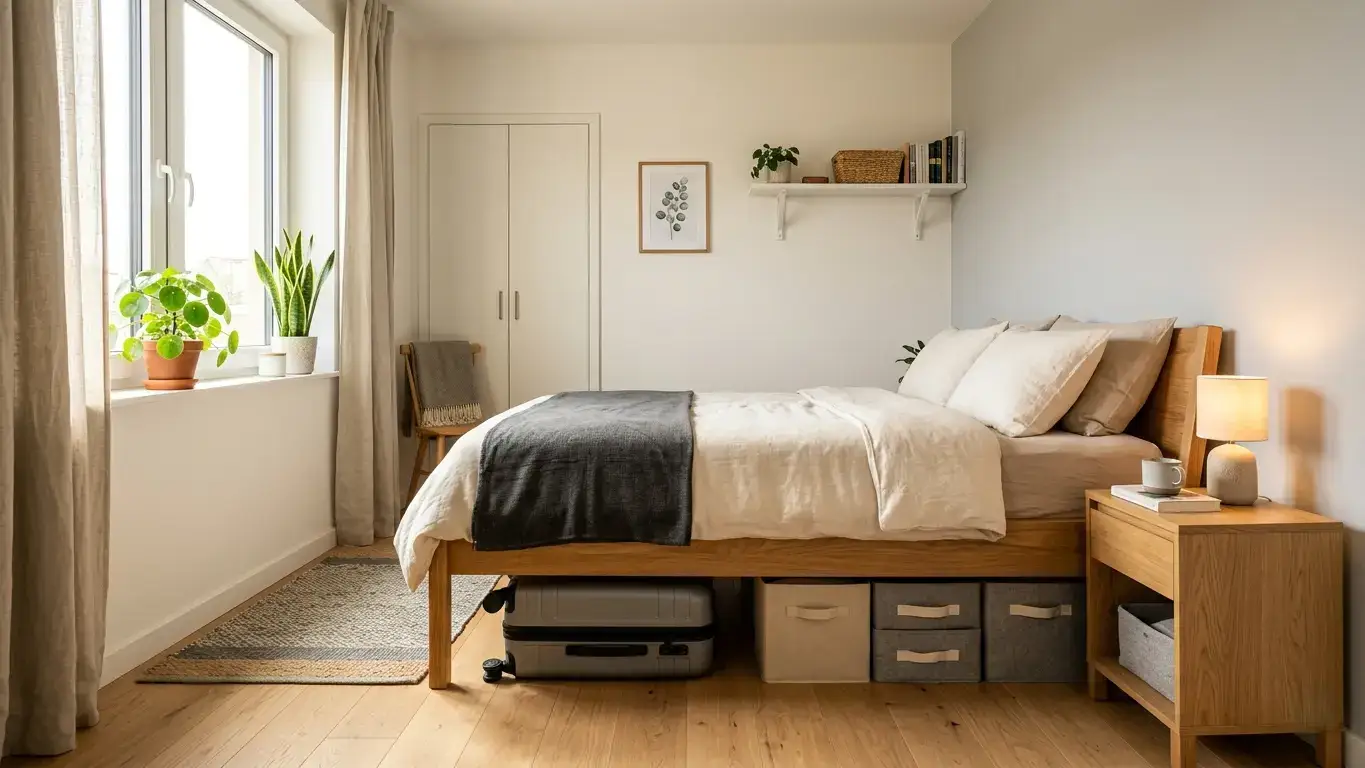
Storage is one of the main reasons people choose a platform bed, especially in a small room where every square foot has to earn its place. But the listings are not always honest about what that storage actually looks like in practice. Clearance figures get listed without context. You buy the bed, move it in, and then figure out whether your suitcase fits.
So here is a practical breakdown of what you are actually working with, across the different platform bed types, so you can decide before delivery day rather than after.
The depth is what matters most
When people talk about under-bed storage, they usually focus on floor area. But the number that actually determines what fits is the clearance height, the gap between the floor and the underside of the platform.
Most platform beds give you somewhere between 12 and 18 inches of clearance. That range sounds narrow, but the difference between 12 and 18 inches is significant in terms of what you can store there.
At 12 inches, you can fit flat storage bins, rolled clothing, bedding bags, and most suitcases laid flat on their side. A standard carry-on suitcase is around 9 to 10 inches deep, so it slides under cleanly. A full-size checked suitcase is typically 11 to 12 inches deep, so it is borderline depending on the exact frame.
At 14 to 16 inches, things open up considerably. Most checked suitcases fit with room to spare. Standard storage boxes and underbed organisers fit upright rather than on their side, which means more usable volume. Bulky items like rolled yoga mats, folded extra pillows, and even small flat boxes from deliveries can find a home there.
At 18 inches, the clearance is generous enough for large checked luggage, stacked storage bins, and seasonal items that tend to be awkward shapes. The Zinus Van 16-inch frame, for instance, gives you 16 inches of clearance, which in a small room is a meaningful amount of storage floor space.
As a rough guide: a standard queen bed is around 60 by 80 inches, which means roughly 33 square feet of floor area underneath. At 14 inches of clearance, that translates to around 270 to 280 litres of usable storage volume. Not all of it is easily accessible from the sides, but most of it is reachable if you are not packing it too deep.
Whether all of that translates to genuine space saving in a small room depends on more than just clearance height. How a platform bed affects the total floor plan of a bedroom is covered in the article on whether a platform bed actually saves space.
For comparison, a queen bed at 12 inches of clearance gives you closer to 230 litres, and at 16 inches you are looking at around 310 litres. So the difference between a low-clearance frame and a higher one, over the same bed size, is roughly 80 litres of storage. That is worth knowing when you are comparing frames.
How bed size affects total storage
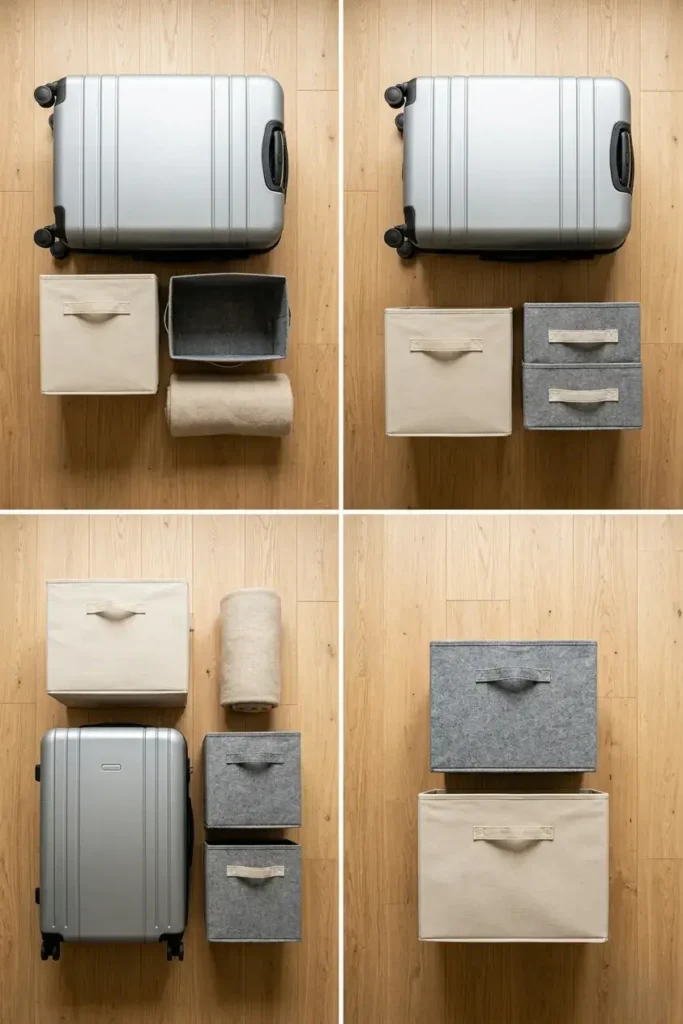
The clearance height sets the depth. But the total storage you get also depends on the footprint of the bed, which varies by size.
| Bed size | Approx. floor area underneath | Storage volume at 12 inches | Storage volume at 16 inches |
| Twin (38 x 75 in) | Around 20 sq ft | Around 140 litres | Around 185 litres |
| Full (54 x 75 in) | Around 28 sq ft | Around 200 litres | Around 265 litres |
| Queen (60 x 80 in) | Around 33 sq ft | Around 230 litres | Around 310 litres |
| King (76 x 80 in) | Around 42 sq ft | Around 295 litres | Around 395 litres |
These are approximate figures based on typical frame dimensions. Actual usable volume will vary depending on leg placement, centre support beams, and how close to the edge you can actually reach. Still, the numbers give you a useful starting point when comparing options.
For practical terms: a queen bed with 16 inches of clearance will comfortably fit two large checked suitcases, a set of storage bins, and a bag of spare bedding. A twin with 12 inches of clearance will fit flat bins and a carry-on, but not much else. If storage is genuinely important to you, size and clearance both matter, not just one or the other.
Platform beds with drawers
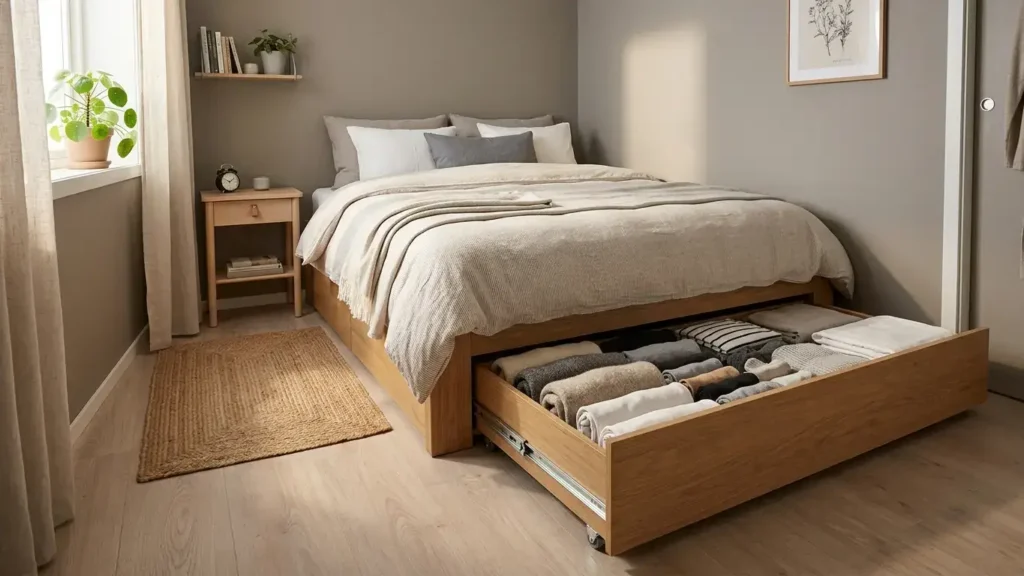
Built-in drawers change the equation entirely. Instead of open floor space, you get enclosed compartments with a defined shape. That trade-off has real implications worth understanding before you buy.
What you gain
Drawers look cleaner. Nothing is visible from outside the bed. The room reads as tidy regardless of what is inside the drawers. For anyone who cares about how the bedroom looks, or who has guests regularly, this matters a lot more than the storage volume number.
Additionally, drawers with wheels or smooth runners make access easy. You pull out the drawer, take what you need, push it back. No crouching down with a torch trying to locate something at the back of the underbed space.
Beds with drawers also tend to have a stronger structural foundation. The drawer units add rigidity to the base. That extra strength means the frame handles weight better overall, which is reassuring if you have children who treat the bed as a trampoline.
What you give up
The main limitation is flexibility. Open under-bed space accepts almost any shape or size of item. Drawers require you to store things that fit the drawer dimensions. A large suitcase, for instance, will not fit in a standard platform bed drawer regardless of how deep the clearance is. You work around the drawer, not the other way round.
Material also matters more with drawers than with open storage. Budget frames often come with fabric-sided drawers or thin plastic runners. Those work fine for clothes, bedding, and light items. However, they are not designed for heavier loads, and the fabric sides can sag or tear over time. If you plan to store books, equipment, or anything substantial, look specifically for wooden drawers on proper runners or wheels. A drawer that drags across the floor instead of rolling will damage carpet and tile over time.
As a general guide, fabric or plastic drawers are suitable for items up to around 15 to 20 pounds. Solid wood drawers on proper wheels handle considerably more, though always check the weight rating on the specific product before assuming.
The shelf-style option
There is a third type that sits between open storage and pull-out drawers, and it tends to get overlooked. Some platform frames have fixed shelf compartments built into the base. You slide items in from the side rather than pulling out a drawer. Think of it as an open cubby built into the frame.
These work well for items you access occasionally but want to keep contained. Boxes, baskets, and fabric storage cubes fit naturally into these compartments. Because there is no drawer mechanism to maintain, they tend to be structurally straightforward and less likely to develop issues over time. The limitation is that you cannot pull the storage surface out toward you, so items at the back require a bit more reaching.
Ottoman beds: a different scale entirely
If maximum storage is the priority, an ottoman bed operates in a different category. Rather than using the clearance underneath, an ottoman bed has a hydraulic lift mechanism. The entire mattress platform lifts up on gas pistons to reveal a large enclosed storage area below.
A standard double ottoman bed typically offers 400 to 500 litres of storage. A king-size ottoman can offer considerably more. Crucially, that storage is enclosed, dust-free, and accessible in a single lift. It suits bulky seasonal items, spare duvets, luggage, and anything you want completely out of sight.
The trade-off is that this is not daily-access storage. Lifting the mattress platform, by definition, requires the bed to be unoccupied and the bedding removed or pushed aside. For things you need every day, it is not practical. For things you reach for once a month or less, it is extremely efficient.
For a deeper look at how ottoman storage compares, the guide to storage beds for small bedrooms covers the full range of options including ottoman beds with specific capacity figures.
Low-profile frames and floor beds
On the opposite end of the spectrum, some platform frames sit very close to the floor, sometimes as little as 4 to 6 inches of clearance, or no clearance at all on floor-level designs. These frames will not give you meaningful storage underneath. What they offer instead is a cleaner, more minimal look. The bed sits low, the room feels more open, and there is no visible gap underneath to manage or hide.
For some people, particularly those who prefer a Scandinavian or Japanese-inspired aesthetic, this trade-off is exactly right. The storage question simply does not apply because it was never the priority.
One thing most listings get wrong
A lot of product listings advertise clearance height without mentioning that the centre support beam or the leg placement can reduce usable space in specific areas. On some frames, the centre legs take up floor space underneath and create sections you cannot reach from either side. Before buying, check the product images carefully for any central support structures that might interrupt the storage area.
Similarly, if the bed has legs at the corners only, items stored near the middle of the bed may be harder to reach from the sides, even if the clearance height looks generous on paper.
Hiding what is underneath
One practical note for open under-bed storage: a fitted bed skirt or a valance that extends to the floor hides everything underneath from view. It is a simple and inexpensive way to get the storage benefit without the room looking like you just pushed things under the bed and hoped for the best. Guests see a tidy bed. You know there are two suitcases and a bag of winter jumpers under there. Everyone is happy.
Ultimately, the right storage setup depends on what you actually need to store, how often you need to access it, and how important the appearance of the room is to you. A straightforward open-clearance frame is versatile and affordable. Drawers are tidier but more structured. An ottoman bed maximises capacity but requires occasional rather than daily access.
When you are ready to compare specific frames with their exact clearance figures and storage configurations, the guide to the best platform beds for small bedrooms has the dimensions listed for each pick.