
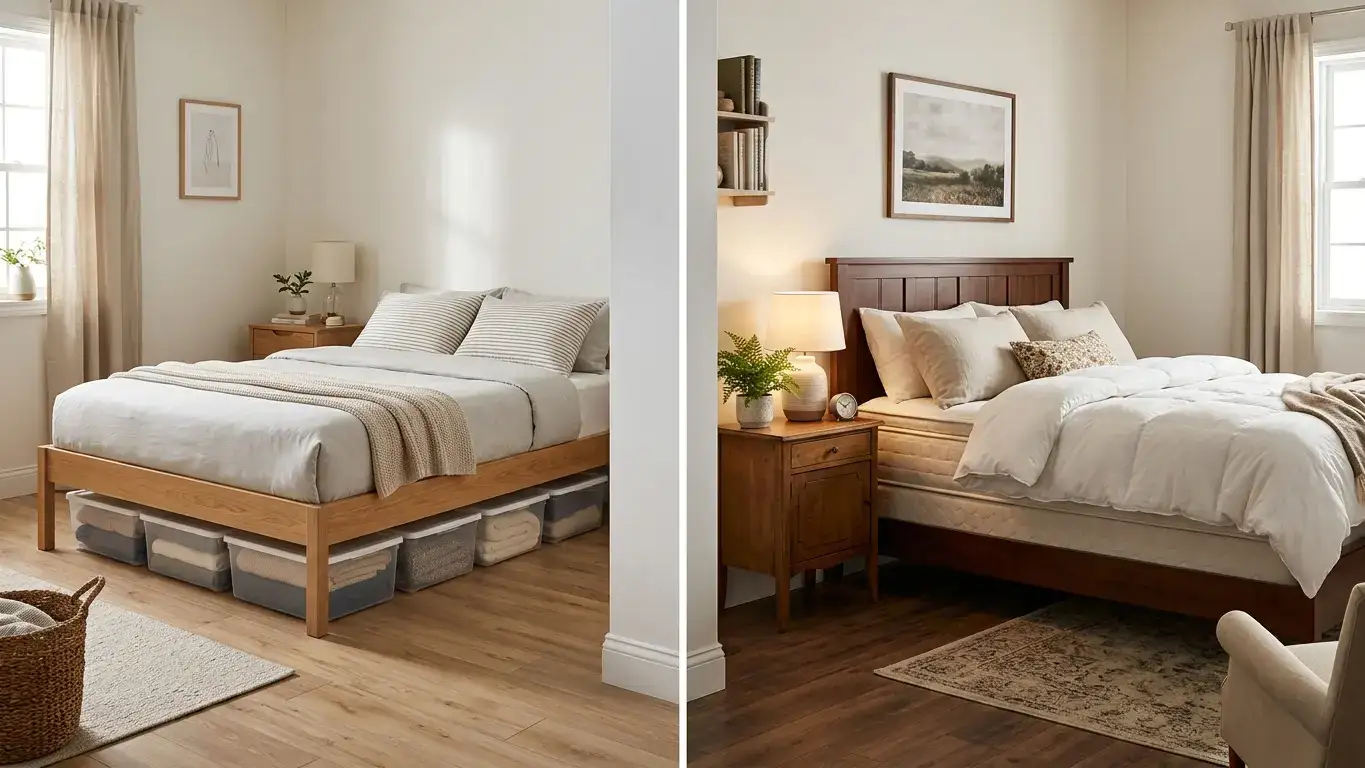
A platform bed and a box spring bed are not just two different products. They represent two different ideas about how a bed should work. One is simple by design. The other adds a layer, literally and figuratively, that made sense once and that most people keep buying out of habit.
This article is not here to tell you that one is always better than the other. It is here to give you a clear picture of what each one actually involves, what you gain and what you give up, so you can make the decision yourself.
If you are not yet sure what a platform bed is or how it differs from a standard frame, the article on what a platform bed actually is covers the basics before you compare.
What you are actually comparing
A platform bed is a frame with a built-in surface, usually wooden slats or a solid panel, that supports your mattress directly. You put the mattress on the frame and you are done. Nothing else needed.
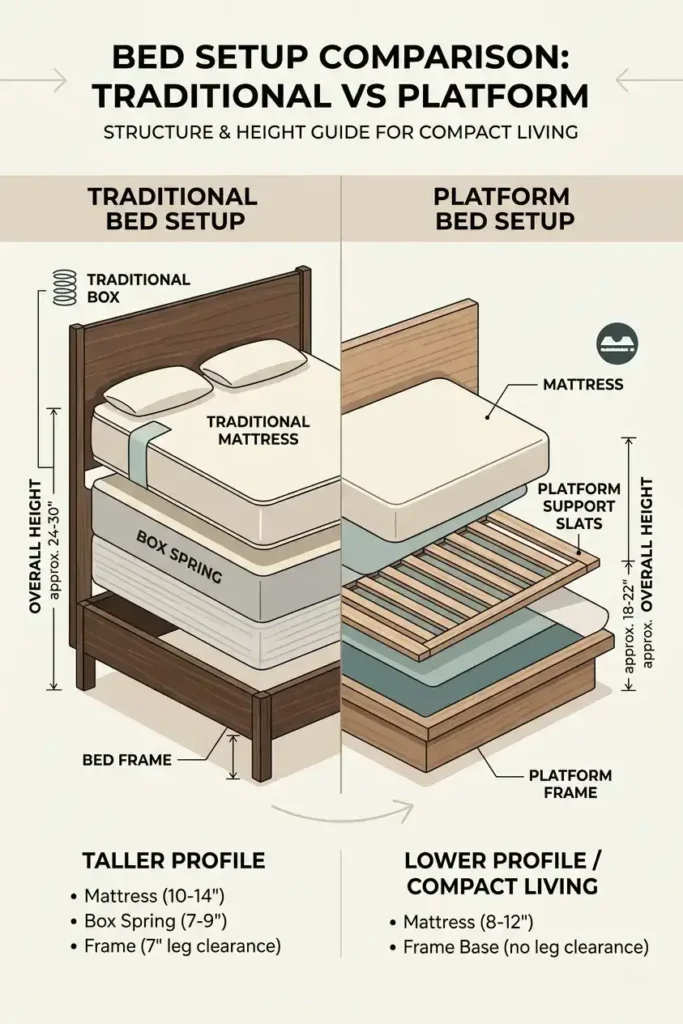
A box spring bed is a frame designed to hold a box spring, which is a separate base unit containing either springs or a rigid interior structure. The mattress sits on top of the box spring. You are buying and maintaining two pieces of furniture instead of one.
The box spring adds height to the bed. It also adds cost, weight, and one more thing to transport when you move.
For decades this was the standard setup because older innerspring mattresses genuinely benefited from the additional give. Modern mattresses, memory foam, latex, and most hybrids, are designed to be used on a firm flat surface. Most manufacturers actually recommend against using a box spring with their current products.
The case for a platform bed
Lower cost overall
When you buy a platform bed, the frame is all you need. No box spring to add to the bill. For budget buyers especially, this matters. A decent platform frame starts at around $70 to $80. A decent box spring on its own can run another $100 to $200 depending on quality. You are saving money before you have even picked a mattress.
For a guest room or a secondary sleeping space used occasionally, a simple metal platform frame is genuinely hard to beat on cost. Put it together, add a mattress, done. No box spring, no additional delivery, no extra piece of furniture to store or move.
Lower profile in a small room
A platform bed sits closer to the floor. Add a standard 10-inch mattress and total sleeping height is usually around 22 to 26 inches. A traditional box spring setup runs closer to 35 to 40 inches. That difference is visible every time you walk into the room.
A lower bed makes a small room feel taller. Your eye has more wall to travel up. In a studio or a small bedroom, that visual breathing room is worth something.
Under-bed storage
Most platform frames give you 12 to 16 inches of clearance underneath. In a small apartment, that space is genuinely useful. Storage bins, suitcases, off-season clothing, extra bedding. Things that would otherwise need a drawer or a wardrobe shelf.
A few things worth being honest about here. Open storage under a bed collects dust. If you are sliding boxes and bins under there and not moving them for months, cleaning underneath becomes a real chore. The stuff is accessible but not particularly visible or organised.
If that bothers you, a platform bed with built-in drawers solves the organisation and appearance problem. The drawers contain the clutter, close flush, and are easy to clean around. They cost more than a basic open-clearance frame but less than adding a separate chest of drawers to the room.
An ottoman bed, where the entire mattress platform lifts on a hydraulic mechanism to reveal storage below, gives you the most storage capacity of any option. The trade-off is that accessing that storage daily is not practical. It is better suited to things you need occasionally, spare duvets, seasonal items, luggage. If you want to explore that option further, the guide to storage beds for small bedrooms covers it in detail.
Less to go wrong
A platform frame is one piece of furniture. There are no springs to wear out, no box spring fabric to tear or sag, and no second unit to replace when it stops doing its job. The maintenance question is straightforward. If the frame is solid, it stays solid.
The case for a box spring
That bounce has its fans
Some people sleep better with the give that a spring base provides. It is not nostalgia. For certain body types and sleep positions, the additional flex genuinely feels more comfortable than a firm flat platform. If you have slept on a traditional setup your whole life and sleep well, changing it is not automatically the right move.
There are people who switched to a platform bed and never looked back. There are also people who tried one and went straight back to a box spring because the sleep was not as good. The honest answer is that your body is not the same as someone else’s. Reviews tell you what worked for other people. Only you can find out what works for you.
Height and ease of use
A higher bed is easier to get in and out of for many people, particularly older adults or anyone with mobility considerations. If getting up from a lower surface is genuinely difficult, a box spring setup keeps the sleeping surface at a height that is easier to manage.
Spend properly if you go this route
This is the part people skip and then regret. A cheap box spring does not protect your mattress or your sleep. The springs compress and lose their shape. The fabric tears and bunches. The frame support weakens.
The money you save buying a low-quality box spring tends to come back in back pain, poor sleep, and an earlier mattress replacement. If a box spring is the right choice for you, invest in a good one. Think of it as part of the cost of a good night’s sleep, not an afterthought.
That principle applies to platform beds too. A very cheap platform frame with thin slats and no central support will not do your mattress or your back any favours. The difference is that a mid-range platform frame is simply more affordable to begin with, so spending a reasonable amount gets you further than the same budget on a box spring setup.
The mattress matters more than you think
Whichever way you go, the mattress is where you sleep. The frame holds it up. Do not scrimp on the mattress to save money on the frame, or the other way round.
On a platform bed specifically, mattress thickness makes a real difference to how the bed feels and looks. A thin mattress on a low platform frame can feel like sleeping close to the floor. A mattress between 8 and 12 inches thick hits the right balance. Too thick and the bed starts to look disproportionate and loses the low-profile effect.
Memory foam and latex mattresses are the most natural fit for platform frames because they need a firm flat surface. Hybrid mattresses work well too. Traditional innerspring mattresses designed to be used with a box spring can technically sit on a platform frame, but they were not built for it and some perform better with the box spring they were designed around.
A quick comparison
| Factor | Platform bed | Box spring bed |
| Cost | Frame only, no box spring needed | Frame plus box spring, higher overall cost |
| Bed height | Lower profile, 12 to 16 inches typically | Higher profile, 25 to 30 inches typically |
| Under-bed storage | Good clearance, 12 to 16 inches | Minimal, box spring fills the space |
| Mattress compatibility | Works best with foam, latex, hybrid | Required for some older innerspring designs |
| Maintenance | One piece of furniture | Two pieces, box spring wears over time |
| Feel and bounce | Firmer surface feel | More give, traditional bounce |
| Best for | Small rooms, budget buyers, storage priority | Those who prefer traditional feel and height |
Which one makes sense for your situation
For a small room where space and budget both matter, a platform bed is the more practical choice in most cases. Lower cost, lower profile, usable storage underneath, and one less piece of furniture to manage.
For a guest room used occasionally, a simple metal platform frame is genuinely hard to improve on. Affordable, functional, and easy to store or move if needed.
For someone who genuinely sleeps better on a traditional spring setup, or who has mobility needs that make a higher bed the right call, a good box spring bed is still the right answer. Just invest properly. The sleep you get back is worth it.
The worst version of this decision is going cheap on both. A low-quality platform frame with a thin mattress is uncomfortable. A cheap box spring with a worn mattress is worse. Pick one direction, spend what is reasonable for it, and get it right.
When you are ready to look at specific platform bed options, the guide to the best platform beds for small bedrooms covers the top picks across metal, wood, and upholstered frames with honest notes on what suits which budget and which room.
And if you are weighing up whether an adjustable base is worth the upgrade over a standard platform frame, that comparison has its own article.