
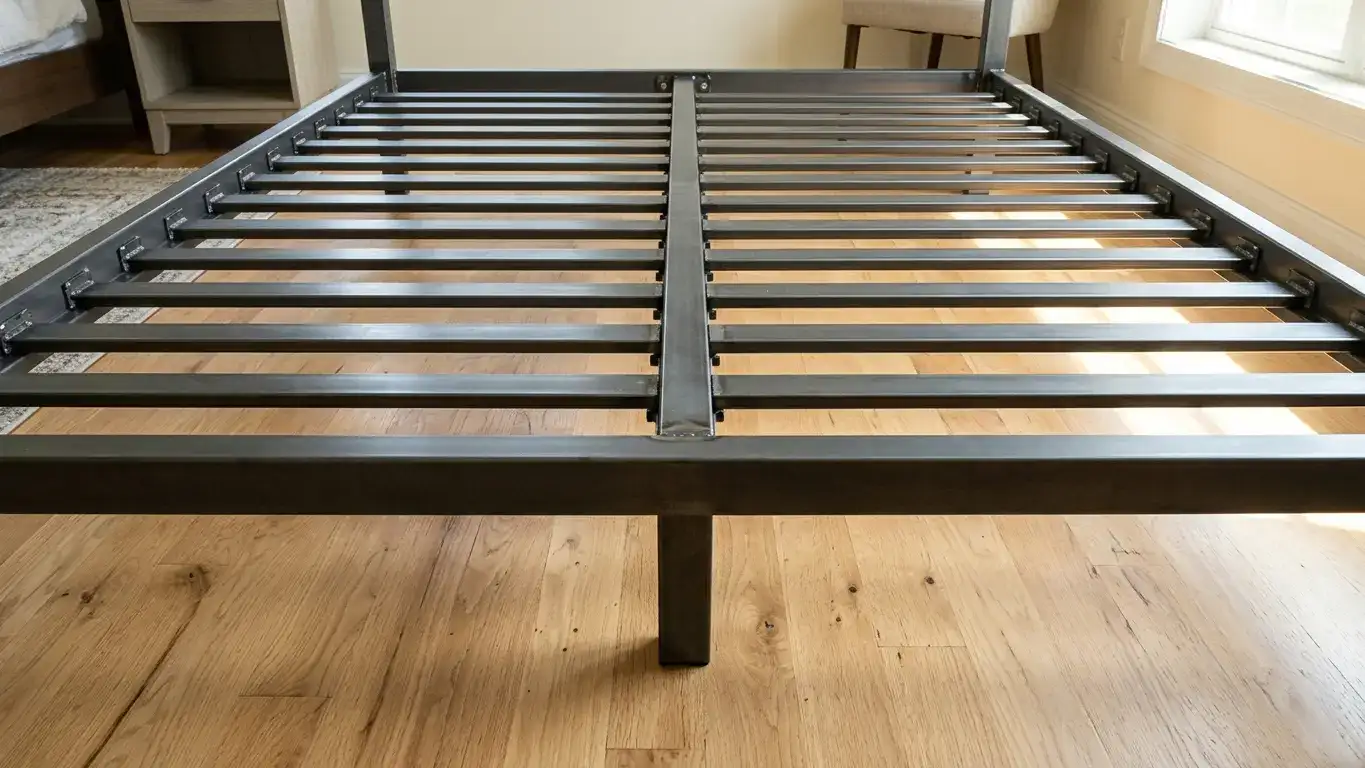
The straightforward answer is yes. Platform beds are sturdy. The design is inherently simple. There are no complicated mechanisms, no folding parts under load, and no structural reason for a well-made frame to give way under normal use. Most people buy a platform bed, assemble it correctly, and sleep on it for years without issue.
That said, reading through thousands of verified buyer reviews across the most popular platform bed frames reveals a consistent set of issues that product listings almost never mention. None of these issues mean platform beds are unreliable. They mean there are specific things worth knowing before you buy, so you do not find yourself on the wrong end of a problem that was entirely avoidable.
Here is what real buyers actually report, after weeks and months of daily use.
The slat issue is the most common complaint
Across nearly every metal platform bed review pool, the slat system generates the highest volume of one-star feedback. The issue takes two forms, and both are worth understanding.
Slats that are too short or poorly retained
On some frames, the crossbars that form the slat surface are slightly shorter than the interior width of the frame. They rest loosely in plastic holders on each side rather than fitting under any tension. Under normal movement, particularly when a person gets on or off the bed, these slats can shift out of their holders. Once a slat drops, the mattress loses support in that area. On cheaper frames, this can happen repeatedly and progressively.
Buyers consistently describe the same pattern: the bed assembles easily and feels fine initially. After a few weeks of use, slats begin shifting. The mattress starts to sag in the affected area. Eventually, the frame becomes unsafe. One buyer described a slat failure that sent a mattress and its occupant through the frame. That is an extreme outcome, but it illustrates what happens when a slat retention problem is ignored rather than addressed.
The fix, in most cases, is simple. If slats are shifting, check that they are seated properly in their holders and that the holders themselves are not cracked or missing. Some buyers solve the issue permanently by placing a plywood board cut to size over the slats, which prevents any individual slat from shifting regardless of the retention quality. It costs very little and entirely solves the problem.
Slat spacing and mattress damage
The second slat issue is spacing. Most mattress manufacturers specify a maximum gap between slats, typically no more than 2.5 to 3 inches, to prevent the mattress from sagging into the gaps over time. Some budget platform frames have slat spacing of 3.5 inches or more. That might not seem like much, but over months of use, a mattress compresses into those gaps repeatedly. The result is premature sagging, reduced support, and in some cases voided mattress warranties.
Before buying any slatted platform frame, check the slat spacing in the product specifications. If it is not listed, look at buyer photos rather than the listing photos. Buyers who have had the bed for several months often show the slat arrangement clearly. Spacing above 3 inches is worth flagging as a risk, particularly if you are pairing the frame with an expensive mattress.
Alternatively, a platform bed with a solid flat base rather than individual slats removes this concern entirely. A solid board base is heavier and less common, but it provides even support across the entire mattress surface with no gaps and no shifting parts. The trade-off is reduced airflow underneath the mattress, which can affect temperature regulation on some mattress types.

Weight capacity is a number people ignore until it is too late
Every platform bed frame has a stated weight capacity. This number is the total load the frame is designed to support, and it includes everything on the frame: the mattress, the bedding, and every person sleeping in the bed.
A common and entirely avoidable mistake is buying a frame whose capacity is just above the buyer’s body weight, without accounting for the mattress. A queen memory foam mattress weighs between 60 and 100 pounds depending on thickness and materials. A hybrid mattress can weigh more. If the frame is rated for 500 pounds and the mattress weighs 80 pounds, the effective capacity for the person or people sleeping on it is 420 pounds, not 500.
Beyond the static weight, dynamic load matters too. Getting in and out of bed, sitting down heavily on the edge, or any concentrated force in a single area exerts significantly more load than the same weight distributed across the mattress. A frame that is rated for exactly the weight it carries has no margin for these normal daily movements. Buyers who exceed the capacity, even briefly and regularly, are accelerating wear on the joints, slats, and support legs.
The practical guide is straightforward. Add the mattress weight to the combined weight of the people sleeping in the bed. Then choose a frame rated for at least 20 to 30 percent more than that total. If the combined load of occupants and mattress is 400 pounds, look for a frame rated for at least 500 pounds. That margin covers dynamic loads and gives the frame genuine longevity rather than just barely surviving its rated limit.
Assembly quality determines long-term performance
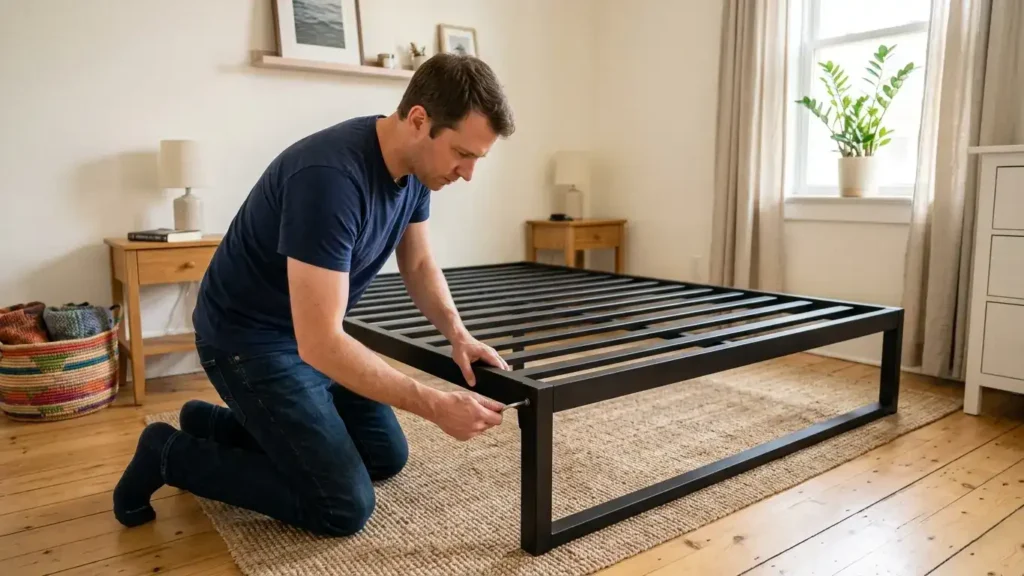
Platform beds are simple to assemble compared to most flat-pack furniture. However, a significant portion of the structural complaints in reviews trace back to assembly issues rather than manufacturing defects. Bolts that are not fully tightened. Legs that are not locked into position. Slats that are not seated properly before the mattress is placed on top.
A frame that wobbles or squeaks after a few weeks is often a frame that was assembled with loose connections rather than a frame that has structurally failed. Before placing the mattress, check every bolt, every leg, and every slat. Tighten anything that has any give. The assembly takes 30 to 45 minutes. The check takes five more. That five minutes is worth doing.
Squeaking, specifically, is almost always a connection issue rather than a frame failure. Metal on metal contact at an undertightened joint produces noise with every movement. The solution is tightening the relevant bolt, sometimes with a rubber washer added to eliminate direct metal contact. Most long-term buyers who report a quiet, solid frame also mention that they checked and retightened bolts after the first month of use.
What the one-star reviews are actually telling you
Reading one-star reviews carefully reveals something important: the majority describe either a defective unit or a misuse situation, not a systemic product failure.
A frame with bent parts from the factory, missing screws, or slats that are measurably too short is a defective unit. These exist in every product category at every price point. A well-reviewed frame with thousands of four and five-star reviews will still produce defective units occasionally. The percentage is small but the absolute number is visible because the review counts are large.
A frame that fails because the user’s weight significantly exceeds the rated capacity, or because slats were not seated properly, or because bolts were never tightened, is a misuse situation. These reviews describe a real problem but not a product defect.
The distinction matters because it changes what you should do. If a defective unit arrives, the response is to contact Amazon promptly, within the return window, with photos of the specific defect. Attempting to assemble a clearly defective product and then seeking help weeks later puts you in a difficult position with customer service, regardless of which brand you bought from. If something looks wrong before assembly begins, stop, photograph it, and contact Amazon before proceeding.
The products recommended in the guide to the best platform beds for small bedrooms are all frames with strong overall ratings across thousands of verified buyers. A four-star or higher rating across a large review pool is a reliable signal that the product performs well in the majority of cases. No product recommendation can guarantee that a specific unit will arrive without defect. What it can tell you is that the product, as a category, delivers on its promise consistently.
Hydraulic and lift-up storage beds deserve a separate note
The reviews shared here include feedback on hydraulic lift-up storage beds, which are a different type of platform bed from the standard fixed-frame options. Hydraulic beds have a mechanism that lifts the entire mattress platform on gas pistons. That mechanism adds complexity that standard platform frames simply do not have.
The complaints specific to hydraulic beds, lift mechanisms that do not hold, pistons that fail to support the weight of the mattress, beds that are impossible to lift solo, are not complaints about platform beds in general. They are complaints about the hydraulic mechanism specifically. A standard fixed platform frame has no lifting mechanism to fail.
If the storage capacity of a hydraulic lift bed is what appeals to you, go in knowing that the mechanism is the component that requires the most attention. Check that it is fully functional before completing assembly. If it does not lift and hold smoothly without the mattress, it will not improve once the mattress is on top.
Practical checklist before and after delivery
Before assembly: check every part against the parts list. Photograph the outer box and the packing condition before opening. If any part looks bent, cracked, or obviously wrong, photograph it before touching anything else and contact Amazon immediately. Do not proceed with a damaged component.
During assembly: read the instructions fully before starting. Tighten every bolt fully as you go rather than leaving them loose until the end. Seat every slat properly and confirm it is retained on both sides before moving to the next step.
After assembly, before placing the mattress: push the frame firmly from each corner and from the centre. It should feel completely rigid with no flex or movement. Check every leg is in contact with the floor. Check the central support leg specifically.
One month after first use: go back and check every bolt. Movement during sleep, even gentle movement, can work bolts slightly loose over the first few weeks. A quick retightening at the one-month mark is the single most effective maintenance step for a long-lasting, quiet frame.
Platform beds are reliable furniture when they are chosen thoughtfully, assembled carefully, and used within their rated capacity. The reviews make that clear when you read them as a whole rather than focusing only on the outliers. The issues that do appear consistently, slat spacing, weight capacity margins, and assembly quality, are all addressable before purchase rather than after.
Might want to check out our article: Platform Bed vs Box Spring: Which One Actually Makes Sense If You’re Short on Space before you make a decision to buy one.