
If you’re furnishing a small apartment and you need something that works as a sofa during the day and a bed at night, a sofa bed and a futon both seem like obvious answers. They solve a similar problem. But once you actually live with one, the differences become clear pretty quickly.
This guide breaks down sofa bed vs futon in plain terms so you can figure out which one makes more sense for your space, your budget, and how you actually use the room.
If you’re still getting your bearings on what a sofa bed actually is and what types are available, our beginner guide on what a sofa bed is covers all of that first.
What Is a Sofa Bed?
A sofa bed is a sofa that converts into a sleeping surface. The most common type is the pull-out sleeper sofa, which has a folded mattress hidden inside the frame. You remove the cushions, pull a handle, and the frame unfolds with the mattress attached.
Other sofa bed designs fold the backrest flat or use a sliding mechanism. What they all have in common is that the sofa function and the bed function are handled separately by the design.
Most sleeper sofas come in full or queen sizes, which means they can comfortably fit two adults.
What Is a Futon?
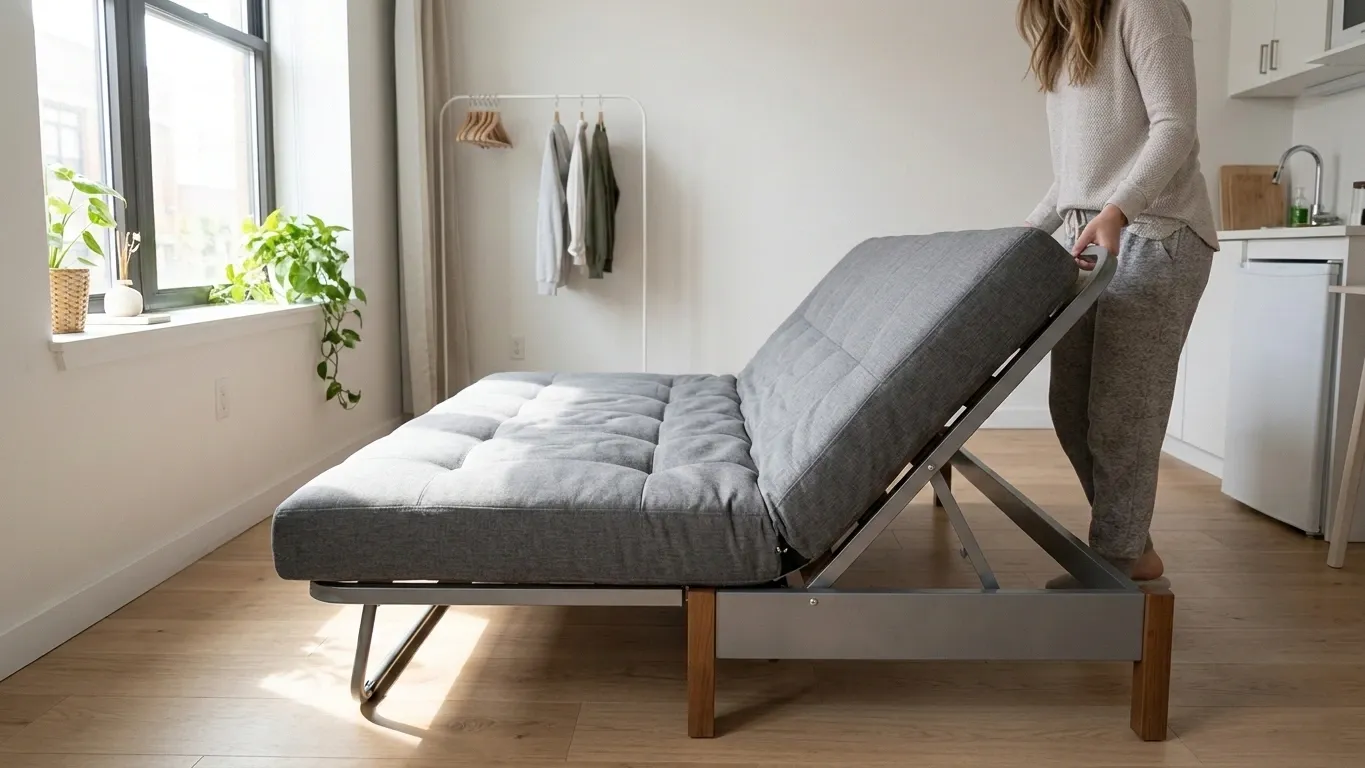
A futon is simpler. The backrest folds down and the whole surface becomes flat. There is no hidden mattress, no metal frame to pull out. The cushion you sit on is the same surface you sleep on.
Futons are lighter, easier to move, and generally more affordable than pull-out sleeper sofas. The trade-off is that the sleeping surface is only as good as the cushion density, and cheaper futon cushions compress noticeably over time.
Space: which one actually takes up less room?
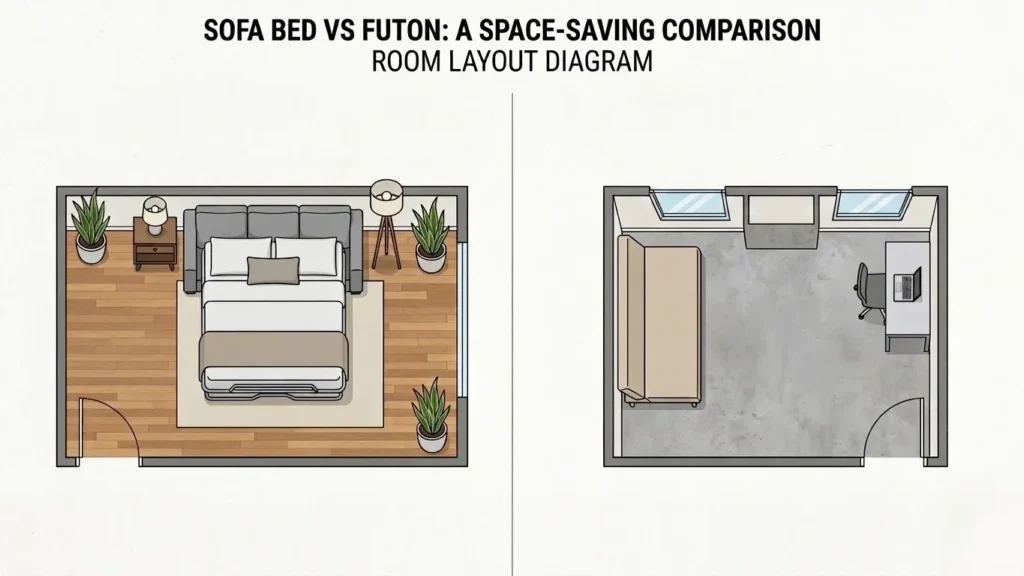
This is where the two options diverge most noticeably in small apartments.
A pull-out sofa bed extends forward when you open it. Most models need around 85 to 90 inches of total depth from the wall when fully open. In a small living room, that forward extension can block walkways, coffee tables, or the path to the kitchen. You usually need to move other furniture before you can even open it properly.
A futon takes up roughly the same floor space whether it’s being used as a sofa or a bed. The footprint barely changes when it folds flat because there is nothing extending outward. For apartments under 400 square feet, or rooms where furniture sits close together, a futon is usually easier to live with day to day.
That said, a pull-out sofa bed’s forward extension only matters when the bed is actually in use. During the day, both options sit against the wall and take up a similar footprint as a sofa.
Comfort: which one sleeps better?
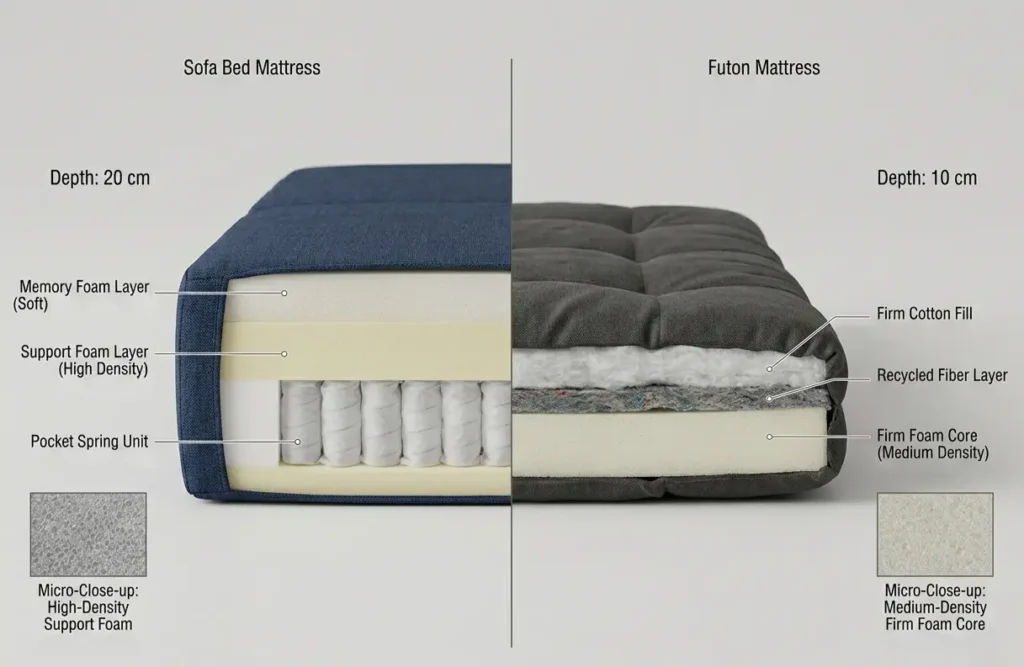
If comfort is your main priority, especially for regular or nightly sleeping, a pull-out sofa bed with a decent mattress is the stronger choice. The mattress is a proper sleeping surface, separate from the seat cushions, and it can be reasonably thick. Memory foam options in particular can feel close to a standard bed for short to medium term use.
Futons are firmer. Some people sleep fine on them, particularly those who prefer a firmer surface. The issue is that because the cushion folds in the middle, you can sometimes feel the fold point, and thinner cushions compress unevenly over time. A high-quality futon mattress addresses this, but it adds cost.
For occasional guests staying a night or two, either option works well enough. For nightly use as your main sleeping surface, a good pull-out sleeper sofa generally holds up better than a futon at the same price point.
We go into more detail on everyday sleeping comfort in our guide on whether sofa beds are comfortable for everyday sleeping.
The mechanism: how each one converts

A futon converts in a single motion. You push the backrest down and it locks flat. Most people can do it in under ten seconds. No cushions to remove, nothing to unfold, nothing to pull out.
A pull-out sofa bed takes a little more effort. You remove the seat cushions, pull the handle or frame forward, and unfold the mattress until it lies flat. The whole process takes a minute or two. It’s not difficult, but it is more involved, and the mechanism can become stiff over time if the frame quality is low.
For daily use, the futon’s simplicity is a real advantage. For occasional guest use, the extra steps of a pull-out sofa bed are a minor inconvenience rather than a genuine problem.
Style: which one looks better in a living room?

A pull-out sofa bed looks like a sofa. The frame and upholstery are designed to read as living room furniture, and when it’s closed you usually can’t tell it converts to a bed at all. This matters in a studio apartment where the living area and sleeping area share the same space.
A futon has a more visible frame and a more casual appearance. This works well in minimalist or student spaces, but it can make a living room feel more temporary. Modern futon designs have improved considerably, but a futon still tends to look like a futon rather than a sofa.
If the room needs to feel like a proper living space during the day, a sofa bed is easier to style. If the space is more functional than decorative, a futon is perfectly adequate.
Durability and maintenance
A futon is mechanically simpler. Fewer moving parts means less that can wear out or go wrong. The hinge is straightforward and easy to maintain. For a rental apartment or a room that gets rearranged occasionally, a futon is generally more resilient over time.
A pull-out sofa bed has more components: the folding frame, the hinges, the springs or slats, and the mattress itself. A well-built sofa bed holds up for years. A cheap one starts to creak, stiffen, or sag within a year or two of regular use. Build quality matters more on a pull-out than on a futon precisely because there is more that can go wrong.
Price: what to expect
Futons are generally cheaper. You can find a functional futon with a reasonable cushion for a fraction of what a decent pull-out sleeper sofa costs. This makes futons a practical starting point when you’re furnishing for the first time or working with a tight budget.
A good quality sofa bed costs more because you’re paying for the internal frame, the mattress, and the mechanism. Budget sofa beds exist, but at the lower end of the price range the mattress quality drops quickly, which defeats the main advantage of choosing a sofa bed over a futon in the first place.
Quick comparison
| Feature | Sofa bed (pull-out) | Futon |
| Sleeping comfort | Generally better, proper mattress | Firmer, depends on cushion quality |
| Space when in use as bed | Extends forward, needs clearance | Minimal footprint change |
| Conversion effort | Remove cushions, pull frame out | Single fold-down motion |
| Sofa appearance | Looks like a proper sofa | More casual, frame visible |
| Weight | Heavier | Lighter and easier to move |
| Durability | Good if well-built, more parts to wear | Simpler mechanism, less to go wrong |
| Price | Mid to high range | Budget to mid range |
| Best for | Regular guests, main living room | Small spaces, tight budgets, simple setups |
Which one should you choose?
Choose a sofa bed if you want better sleeping comfort for guests, if the room is your main living space and the sofa appearance matters, or if your budget allows for a decent quality model with a proper mattress.
Choose a futon if your apartment is very small and floor space is tight, if you’re furnishing on a limited budget, or if you move frequently and need something lightweight and easy to shift around.
There is no universally better option. The right choice depends on how often the bed will actually be used, how the room needs to look during the day, and what you can realistically spend.
If a sofa bed is where you’ve landed, our guide to the best sofa beds for small apartments covers the top picks with honest assessments of sleeping comfort and mechanism quality.
And if you’re considering a daybed as an alternative to either option, our comparison of a daybed versus a sofa bed covers how the two differ in small apartment settings, which is worth reading if you’re still weighing your options.
If you want to understand how futon mattress construction compares to standard mattress materials, the Sleep Foundation’s guide to mattress types is a useful reference for understanding what foam density and fill quality actually mean for long-term comfort.