

Pull-out couch. Sofa bed. Sleeper sofa. These terms get used interchangeably by retailers, reviewers, and even furniture brands. And honestly, the confusion is understandable.
But there is a real difference, and it matters more than most people realise when they’re actually shopping for one.
Here’s how to tell them apart, and why the distinction should affect the one you choose.
Why the confusion exists
The furniture industry has never settled on consistent naming. One brand calls it a sofa bed couch. Another calls the same product a pull-out sofa. A third lists it as a sleeper sofa.
The reason this happens is that sofa bed is a broad category. It covers any piece of furniture that functions as both a sofa and a bed. A pull-out couch is one specific type within that category, but retailers don’t always make that distinction clear.
If you’ve been reading product listings and finding them confusing, that’s not you. The naming is genuinely inconsistent. What matters is understanding the mechanism, not the label.
If you’re still getting to grips with the full range of options, our guide on what a sofa bed actually is covers all the main types in one place.
What a pull-out couch actually is
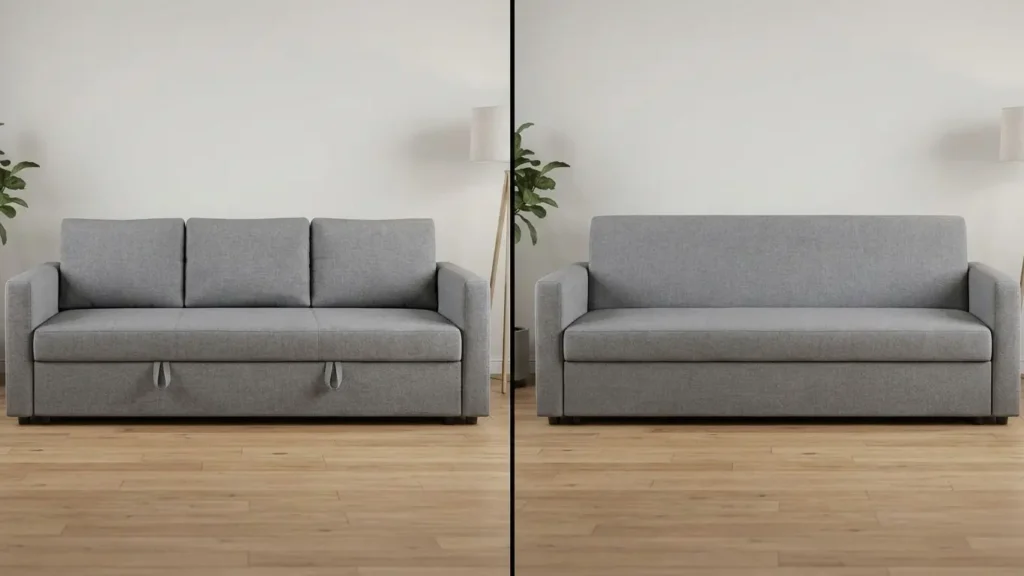
A pull-out couch has a hidden mattress stored inside the frame. You remove the seat cushions, pull a handle on the metal frame, and the mattress unfolds forward until it’s flat.
The mattress is completely separate from the seat cushions. It’s folded into the frame during the day and only comes out when you need it. This is also what most people mean when they say sleeper sofa.
Because there’s a real mattress involved, a quality pull-out couch tends to feel closer to sleeping in an actual bed than most other sofa bed designs. You’ll find them in twin, full, and queen sizes. The sleeper sofa queen is the most common for guest use, since it’s wide enough for two adults.
The trade-off is weight and clearance. The internal frame and mattress add significant weight compared to a standard sofa. And when the bed is open, it extends forward, so the room needs clear floor space in that direction.
What sofa bed actually covers
Sofa bed is the wider category. It includes the pull-out couch, but it also covers:
- Futon-style sofas where the backrest folds flat and the cushion becomes the sleeping surface
- Click-clack sofas that tip back into a reclined or flat position
- Corner sofa beds where a section of the frame slides or folds out
- Sectional sleeper sofas with a hidden mattress built into one section
The key difference across all of these is whether there’s a dedicated mattress inside the frame or whether the seat cushion is doing double duty as both seat and sleeping surface.
A pull-out couch always has a dedicated mattress. Other sofa bed types may not. That single factor affects comfort more than anything else.
The naming confusion in practice
Here’s a straightforward way to think about it:
- Every pull-out couch is a sofa bed
- Not every sofa bed is a pull-out couch
When a retailer lists something as a sofa bed without further detail, check the product images for a metal frame or a handle on the front. If you can see those, it’s a pull-out. If the backrest simply tilts back, it’s a fold-flat design.
The name on the listing tells you almost nothing. The mechanism tells you everything.
If you’re specifically trying to understand the difference between a sofa bed and a sleeper sofa as terms, our article on that exact distinction keeps it straightforward.
Comfort: does the type make a difference?
Yes, significantly.
A pull-out couch with a good quality mattress, particularly one with memory foam or a pocket spring layer, can be genuinely comfortable for most adults for several nights. The mattress is a real mattress, even if it’s thinner than what you’d find on a standard bed frame.
Fold-flat sofa beds rely entirely on cushion density. A well-made futon cushion can work for occasional use. A cheap one will feel like a folded blanket by the second night. There’s no separate mattress to compensate.
One thing that catches people out with pull-out couches is the metal bar issue. On older or cheaper models, the bar where the frame folds can press through a thin mattress and become noticeable during the night. Better quality models have addressed this with thicker mattresses and improved frame design, but it’s still worth checking reviews specifically on this point before buying.
For a proper look at comfort across all sofa bed types, including which ones hold up for regular nightly use, our guide on whether sofa beds are comfortable for everyday sleeping covers it honestly.
Space and layout: what to measure before you decide
This is where the pull-out couch has a specific requirement that other sofa bed types don’t.
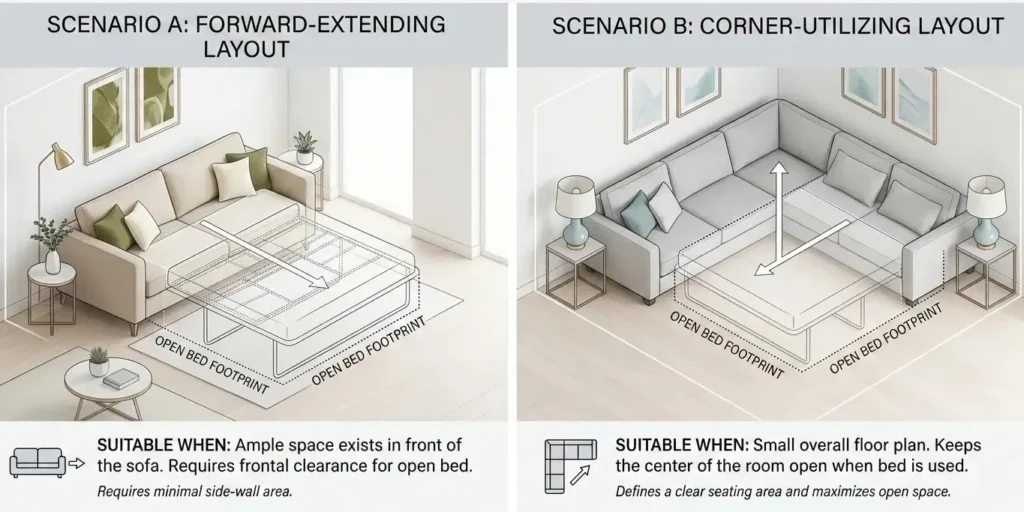
When a pull-out opens, it extends forward from the sofa. Depending on the model, the fully open bed can extend 85 to 100 inches from the wall. That means you need clear floor space in front of the sofa roughly equal to the length of the mattress when the bed is in use.
In a small apartment this often means the coffee table needs to move, or the bed blocks a walkway. It’s not a dealbreaker, but it needs to be planned for.
Fold-flat sofa beds have a different profile. They generally sit slightly further from the wall than a standard sofa when in use, but they don’t extend forward in the same way. Side clearance matters more than frontal clearance with these designs.
Corner sofa beds and sectional sleeper sofas use the room differently again, since they sit against two walls rather than one.
Cost: what drives the price difference
Pull-out couches are generally more expensive than simpler sofa bed designs. The internal frame, the separate mattress, and the folding mechanism all add to the manufacturing cost.
A basic fold-flat sofa bed or futon can be considerably more affordable, which makes them a popular first choice for studio apartments and student rentals.
The cost gap narrows when you factor in mattress quality. A cheap pull-out couch with a thin mattress often ends up less comfortable than a well-made futon with a dense cushion, despite costing more. Price alone is not a reliable guide here.
Quick comparison
| Feature | Pull-out couch | Other sofa bed designs |
| Mattress type | Dedicated mattress stored inside frame | Seat cushion or fold-flat surface |
| Mechanism | Metal frame pulls forward, mattress unfolds | Backrest folds flat or tips back |
| Comfort potential | Higher, closer to a real bed | Depends entirely on cushion quality |
| Floor clearance needed | Significant frontal clearance required | Less frontal clearance, more depth |
| Weight | Heavier due to internal frame | Lighter on simpler designs |
| Price | Generally higher | More budget-friendly options available |
| Best for | Regular guest use, better sleep quality | Small spaces, occasional use, lower budget |
Which one should you choose?
If the sofa bed will be used regularly by guests or as a daily sleeping surface, a pull-out couch with a proper mattress is the more honest answer. The sleeping experience is meaningfully better when there’s a real mattress involved, and the investment holds up over time if the frame is well built.
If the sleeping use will be occasional, the space is tight, or budget is the main constraint, a fold-flat sofa bed or futon design makes practical sense. The simplicity also means fewer things to maintain or replace over time.
Whatever you choose, measure the room in bed position first, not sofa position. That single step prevents the most common mistake people make with this type of furniture.
When you’re ready to look at specific options, our guide to the best sofa beds for small apartments covers the top picks across different types and price points, with honest notes on which ones are actually worth buying.
If you’ve been comparing a sofa bed against a daybed and aren’t sure which direction makes more sense for your room, our guide on the difference between a daybed and a pull-out couch looks at both options from the perspective of someone furnishing a small room.
If you want a practical reference before buying any large piece of furniture for a small space, the Apartment Therapy guide on space planning and measuring tips for furniture covers the key steps clearly, including doorways and clearance that most people forget to check.